




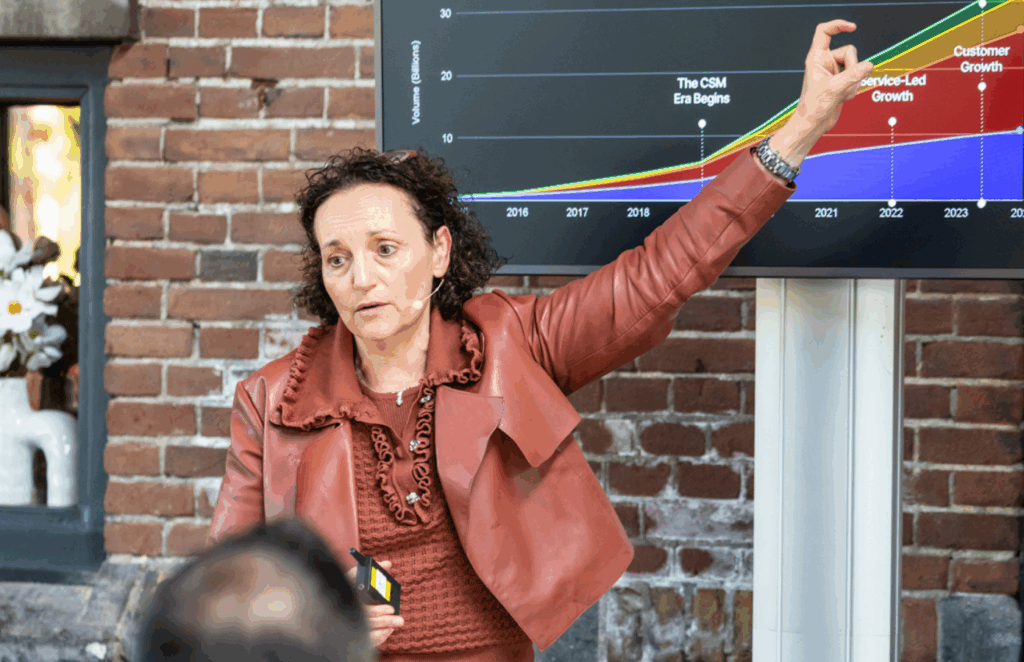
Customer Success has become the growth engine of modern SaaS, but behind the scenes, too many teams are quietly burning out. CSMs are juggling revenue targets, growing portfolios, and endless internal demands—all while trying to deliver “customer obsession” at scale. Hybrid work adds flexibility but often leads to isolation. The result? Fragile performance and exhausted teams.
At Mollie, a European payments company serving over 250,000 active businesses, this challenge became impossible to ignore. As the company expanded across new markets, VP of Customer Success and Support Stefanie Richheimer saw that success wasn’t just about scaling customer outcomes—it was about sustaining the people behind them.
Her team of nearly 100 spans multiple countries and functions, from support hubs in Maastricht and Lisbon to local CSMs embedded in markets across the Netherlands, Belgium, Germany, the UK, and France. With such scale, Stefanie had to rethink how to protect team health without slowing growth.
Building a system for performance and protection
Stefanie calls it the balancing act—designing a Customer Success organization that performs without breaking. Her approach can be applied by any SaaS company between €2M and €200M ARR.
It rests on a few key principles: clarity of roles, layered service models, smart capacity planning, and the courage to formalize wellbeing as an operational priority.
1. Clarify the job and remove hidden work
One of the fastest paths to burnout is unclear expectations. Many CSMs are quietly carrying “invisible work”—from internal escalations to product feedback—that never appears on a KPI dashboard.
Stefanie tackled this by formally redefining responsibilities across her organization. At Mollie, Customer Success now focuses on retention, adoption, and light upsell, while Account Managers own expansion, pricing, and larger commercial negotiations. A new Renewal Manager role covers contract management for enterprise clients.
Different roles have different incentive models to reflect accountability. This clarity reduces internal friction and ensures that every team member knows exactly where to focus.
2. Segment service layers by motion, not just logo size
Instead of a one-size-fits-all structure, Stefanie designed distinct service layers based on how customers engage, not just how big they are.
- Support handles one-to-many reactive requests with strict SLAs.
- Premium Support gives localized, high-touch help for priority accounts.
- Customer Growth bridges the gap between service and sales, using two roles:
- Customer Success Representatives manage inbound commercial requests, turning them into quick wins.
- Customer Growth Representatives run proactive, one-to-many outreach across thousands of accounts.
- Customer Success Representatives manage inbound commercial requests, turning them into quick wins.
- Customer Success Managers (CSMs) focus on one-to-one relationships with strategic customers, managing between 55 and 120 accounts depending on complexity and region.
This layered structure keeps workloads balanced and allows the right type of attention for every customer segment.
3. Use service-led growth to turn conversations into value
When Stefanie introduced “service-led growth,” she proved that support teams could drive revenue without becoming salespeople.
By training them to take a consultative approach—asking questions about product fit, expansion, or new features—support became a source of customer insight and incremental revenue. The goal wasn’t to sell; it was to improve the customer experience. As Stefanie puts it, “If a customer reaches out, why not use that moment to make their experience better?”
4. Localize relationships, centralize scale
Mollie’s structure balances global efficiency with local connection. Support and Customer Growth are centralized in operational hubs for efficiency, while CSMs stay in-market to build trust and context.
This dual model ensures scale where it makes sense—shared tools, processes, and reporting—without losing the nuance that comes from local, relationship-driven work.
5. Build a dynamic capacity model
Capacity is strategy. Stefanie’s team models account load not just by number, but by complexity, product mix, and incident risk.
High-touch marketplace clients, for example, demand far more time than a straightforward e-commerce store. Her team also budgets for unpredictability: outages, seasonal spikes, or even staff leave.
And when people go on maternity or long-term sick leave, the team no longer redistributes 100 unmanaged accounts to others. “We tried that once,” Stefanie admits, “and six months later, half the team was burned out.” Now, leave coverage is factored directly into budget and headcount planning.
6. Design incentives that match the craft
Healthy incentives create focus. Unhealthy ones cause exhaustion. Stefanie’s 2026 plan differentiates compensation for CSMs and Account Managers: the former rewarded for retention and adoption, the latter for expansion and revenue.
It formalizes what people were already feeling—that the roles require different muscles—and helps each person grow in the direction that fits their strengths.
7. Run hybrid as a team sport, not a solo sport
Hybrid work offered flexibility but also made burnout harder to see. “Many CSMs started to feel isolated, carrying tough accounts alone,” Stefanie says. Mollie now encourages regular office days for collaboration, coaching, and problem-solving.
These in-person rituals aren’t optional—they’re performance enablers. They help teams share context faster, decompress after stressful days, and maintain a sense of belonging.
8. Operationalize incident readiness
When every second of downtime matters, CSMs and Support need clear playbooks. Stefanie’s teams rehearse incident scenarios, align communication channels, and conduct after-action reviews to improve.
This readiness removes stress in high-pressure moments and ensures customers experience confidence, not chaos.
9. Make team health measurable
Team health isn’t a nice-to-have; it’s an operational metric. Mollie tracks workloads, meeting cadence, and engagement pulses across teams. Managers are encouraged to treat energy as seriously as revenue.
“Customer Success is the heart of the company,” Stefanie reminds her peers. “If the heart stops beating, everything else stops too.”
What happens when you get this right
When wellbeing and performance align, everything compounds. Support resolves faster. Customer Growth drives expansion. CSMs spend time on real value creation instead of firefighting. Product feedback improves. Renewals become predictable.
Most importantly, people stay energized enough to do their best work for years—not quarters.
Final takeaway
Customer Success can only thrive when the people behind it do. Stefanie Richheimer’s model at Mollie proves that you can grow fast and stay healthy—with clear roles, structured capacity, and human-centered design.
As she puts it: “Love your customers. Take care of your people. Do both, and the business will take care of itself.”
Watch Stefanie’s full keynote from SaaSiest Amsterdam 2025 here: https://saasiest.com/the-balancing-act-sustaining-csm-preventing-overload/