





For most SaaS founders, strategy feels like something you worry about later.
First you build the product. Then you find customers. Then you survive. Somewhere after product-market fit, strategy appears – usually in the form of planning sessions, PowerPoint decks, and discussions about three-year roadmaps.
Execution is what matters. Strategy can wait.
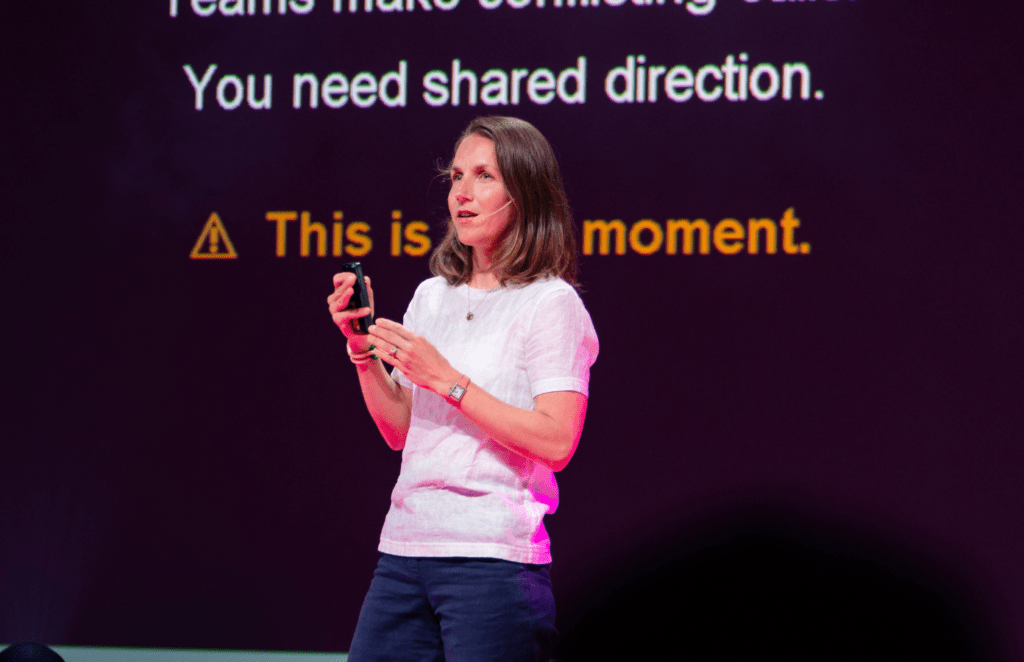
At SaaSiest 2026, Anni Tuulos, SVP Strategy and Corporate Development at RELEX Solutions, argued that this mindset works surprisingly well – until it suddenly doesn’t.
Because the moment a company reaches a certain size, execution alone stops being enough.
The challenge is no longer getting people to work hard.
It’s getting everyone to work in the same direction.
The Founder Eventually Stops Being the Strategy
In the earliest stages of a startup, alignment happens almost automatically.
The founder is involved in nearly every important decision. Product priorities, customer conversations, hiring decisions, partnerships – everything flows through one person who has a clear vision of where the company is going.
Nobody needs a formal strategy because everyone can simply ask the founder.
As companies grow, that operating model quietly breaks down.
New teams appear. Managers make independent decisions. Product, Sales, Customer Success and Marketing all optimize for different outcomes. Hundreds – eventually thousands – of decisions are made every single day without the founder being involved.
Individually, those decisions often make perfect sense.
Collectively, they can slowly pull the company in different directions.
According to Anni, this is the point where strategy starts creating real value. Not because the company suddenly needs more planning, but because it needs a mechanism for keeping everyone aligned when the founder can no longer be in every room.
Strategy Isn’t About Predicting the Future
One of the biggest misconceptions about strategy is that it’s supposed to predict what the business will look like three years from now.
Especially in the age of AI, that feels almost impossible.
Markets move faster than annual planning cycles. Customer behaviour changes. New competitors emerge overnight. Entire product categories appear in months rather than years.
So why spend time building a long-term strategy if it’s almost guaranteed to change?
Anni’s answer was refreshingly practical.
The value of strategy isn’t accuracy.
It’s direction.
People don’t need a perfect prediction of the future. They need enough context to make better decisions today. A strategy gives employees confidence that the work they’re doing now contributes to where the company wants to be in the future, even if that destination evolves over time.
Without that shared direction, execution becomes reactive instead of intentional.
The Most Important Part of Strategy Is Saying No
Growing SaaS companies rarely struggle with a lack of opportunities.
They struggle with too many.
Customers request features. New markets become attractive. Adjacent products seem promising. Partnerships appear. Every opportunity looks capable of generating growth.
The natural instinct is to keep saying yes.
Over time, that creates an organisation that’s incredibly busy but increasingly unfocused.
Anni described strategy as the mechanism that helps companies make choices. Not just about where they want to win, but equally importantly, where they don’t.
That distinction matters.
Every strategic decision creates trade-offs. Every priority implies something else becomes less important. Without those trade-offs, strategy becomes little more than a list of ambitions.
A useful strategy gives teams permission to decline opportunities that don’t move the company closer to its long-term goals.
Alignment Happens Through Decisions, Not Documents
One of the most practical frameworks Anni shared was how strategy should cascade through an organisation.
It starts with a long-term destination. For example, reaching a specific ARR target within three years.
That destination then needs to be broken down into the handful of growth levers that will actually make it possible. Perhaps expansion into new markets. New product categories. Growth within existing customers. Strategic acquisitions.
Those priorities then become annual company objectives.
Annual objectives become team priorities.
Team priorities become individual goals.
The framework itself isn’t particularly complicated.
What matters is that every person in the company understands how their work contributes to the bigger picture.
If Product is optimising for one customer segment while Customer Success prioritises another, the strategy hasn’t failed because the plan was wrong.
It has failed because alignment never happened.
Speed Makes Strategy More Important, Not Less
One of RELEX’s own priorities this year is increasing organisational speed while becoming more AI-native.
That creates an interesting paradox.
Most people assume faster companies need less planning.
In reality, the opposite is often true.
The faster an organisation moves, the faster it can drift.
When teams ship features, launch experiments and make decisions at increasing speed, even small differences in priorities compound over time. Without a shared understanding of where the company is heading, speed simply helps people move away from each other more efficiently.
Strategy isn’t there to slow the organisation down.
It’s there to make sure speed creates momentum rather than chaos.
A Simple Test for Every Leadership Team
Anni ended with a question that every SaaS leadership team could ask themselves.
What are you willing to stop doing?
Not next quarter.
Today.
It’s an uncomfortable question because most companies are far better at adding priorities than removing them.
But that’s exactly why it’s useful.
If your strategy can’t help your teams confidently decide what not to build, which opportunities not to pursue, or which initiatives no longer deserve attention, then it probably isn’t influencing the business in a meaningful way.
Growing companies don’t usually fail because they lack ambition.
They fail because hundreds of sensible decisions gradually pull the organisation away from the same destination.
The role of strategy isn’t to create another document.
It’s to ensure that everyone is building toward the same future.