





For decades, SaaS companies have obsessed over the same question:
How do we build better software for people?
We invest in beautiful user interfaces, intuitive workflows, onboarding experiences, dashboards, and documentation. Entire product organizations exist to make software easier for humans to use.
But what happens when humans stop being the primary users?
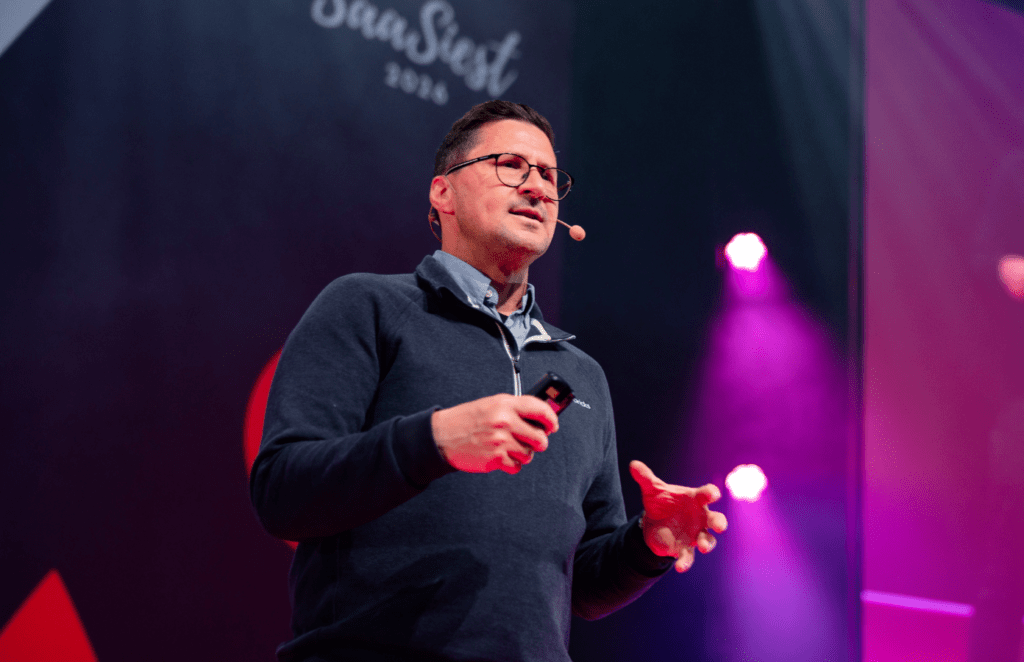
At SaaSiest 2026, Dael Williamson, EMEA CTO at Databricks, argued that this shift is already underway. As AI agents become capable of performing increasingly complex tasks, the software we build will no longer be used primarily by people.
It will be used by other software.
That single idea has profound implications – not just for product design, but for company structures, competitive moats, and even who your competitors will be over the next decade.
The Rise of the Non-Human Employee
Dael opened with an observation that would have sounded absurd just a year ago.
He no longer thinks of AI as a single assistant.
Instead, he manages what he describes as a team.
Some of those team members are human.
Others are not.
Inside Databricks, engineers are increasingly building fleets of AI agents that perform specialized tasks, collaborate through Slack, and improve over time as they’re given more context. These agents aren’t replacing employees. They’re becoming digital colleagues with clearly defined responsibilities.
That changes how work gets done.
Instead of one employee using one AI assistant, organizations are beginning to experiment with networks of agents working together, each responsible for a specific domain.
It’s an early glimpse of how knowledge work may evolve over the coming years.
Your User Interface Is Becoming a Liability
One of the most surprising ideas from the session was Dael’s claim that the traditional user interface may soon become a competitive disadvantage.
Humans need interfaces.
Agents don’t.
In fact, they often struggle with them.
An AI agent navigating a product through buttons, menus, dashboards, and workflows consumes unnecessary tokens, increases latency, and introduces more opportunities for failure. Every additional step makes automation more expensive.
Instead, software increasingly needs a second interface – one designed specifically for machines.
Dael described this as building “headless” products. The human interface still exists, but beneath it sits a richer layer that agents can interact with directly, without having to interpret visual elements intended for people.
For SaaS companies, this represents a fundamental design shift.
The customer experience is no longer just about UX.
It’s about agent experience.
AI Is Changing Who Your Competitors Are
The session also challenged another assumption that many SaaS companies still hold.
Most software businesses think they compete against other software vendors.
Increasingly, they don’t.
Consulting firms are becoming product companies.
Databricks has watched major consulting organizations incubate SaaS products inside their advisory businesses before spinning them out into standalone companies. Their advantage isn’t engineering.
It’s domain expertise.
They already understand customer problems at an incredibly deep level.
AI dramatically lowers the barrier to turning that expertise into software.
As Dael pointed out, every consulting firm is now experimenting.
Some of those experiments will become your next competitors.
Software Is Becoming Cheap. Context Is Becoming Expensive.
Another recurring theme throughout the presentation was the rapidly falling cost of building software.
AI can generate applications, automate workflows, and write enormous amounts of code at a speed that would have seemed impossible only a few years ago.
That doesn’t mean software is becoming easier.
It means the bottlenecks are moving.
The challenge is no longer generating code.
It’s keeping AI systems reliable.
Dael described how the biggest engineering problems inside AI-native companies increasingly revolve around monitoring model drift, testing agent behavior, tracing decisions, and ensuring repeatable outcomes.
In other words, software itself is becoming commoditized.
Operating AI systems is becoming the real engineering discipline.
The New Moat Isn’t the Model
Perhaps the biggest misconception Dael challenged was the idea that proprietary AI models will become long-term competitive advantages.
His view was almost the opposite.
Models are rapidly becoming commodities.
Companies switch between them constantly as costs fall and capabilities improve. Today’s best-performing model may not be tomorrow’s default.
Instead, the durable advantages are emerging elsewhere.
The companies that win will build better orchestration, stronger telemetry, better testing frameworks, and richer operational data.
Those capabilities become increasingly valuable regardless of which underlying model powers the system.
The moat shifts away from intelligence itself and toward the infrastructure that allows intelligence to operate reliably.
Company Structures Are Changing Alongside the Technology
All of this ultimately leads back to the topic of Dael’s session.
AI is changing company structures – not because organizations suddenly need fewer people, but because entirely new roles are emerging.
Engineers increasingly spend time orchestrating agents rather than writing every line of code themselves.
Professional services teams become extensions of product development.
Product teams must think about machine customers alongside human ones.
The boundaries between software, consulting, operations, and AI research begin to blur.
Companies built around traditional SaaS assumptions may find themselves organized around problems that no longer exist.
The Biggest Advantage Right Now Is Curiosity
Dael ended with perhaps the most practical advice of the session.
The companies making the fastest progress with AI aren’t necessarily the ones with the largest budgets or the biggest engineering teams.
They’re the ones that play.
Inside Databricks, experimentation isn’t something employees squeeze into their spare time. It’s expected. Teams are encouraged to spend significant time – and significant token budgets – simply learning how these systems behave.
Because the people who understand AI today aren’t the people who have read the most about it.
They’re the people using it every day.
That may be the simplest competitive advantage available right now.
The AI landscape is changing too quickly for anyone to become an expert through theory alone.
The companies that learn fastest won’t just build better AI products.
They’ll build entirely different companies.