






If there’s one thing Benjamin Lang, Head of Expansion for EMEA at Shopify, has learned—both as an operator and as an Olympic rower—it’s this:
“No one wins alone.”
That principle drives Shopify’s go-to-market strategy. With 100,000+ partners powering its global growth engine, Shopify’s ecosystem isn’t just a lead source – it’s a force multiplier.
At SaaSiest Amsterdam, Benjamin broke down how to build an ecosystem that doesn’t just scale reach – but compounds value through three levers: reach, frequency, and yield.
From product-first to ecosystem-first
A great product helps you move fast.
A great ecosystem makes you unstoppable.
Benjamin framed it simply: growth is no longer about what your internal team can execute—it’s about how effectively your ecosystem can scale that execution for you.
At Shopify, that ecosystem includes agencies, developers, system integrators, tech partners, and investors. Together, they amplify the company’s marketing reach, accelerate deals, and expand product capability.
The result?
- 4x more partners than their nearest competitor
- 40% annual growth
- And a stated ambition that 100% of deals be partner-attached
That scale doesn’t happen by chance. It’s engineered through the Reach–Frequency–Yield (RFY) model.

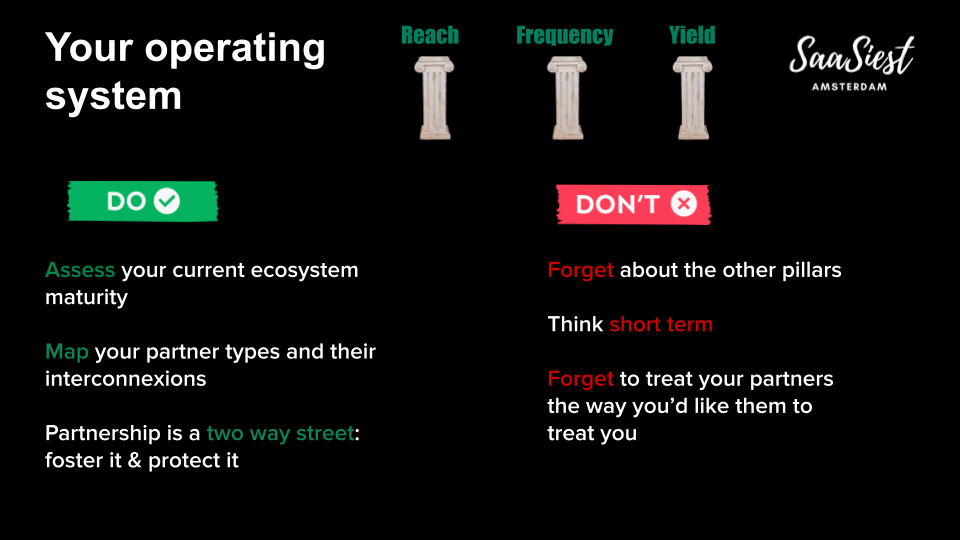
The Reach–Frequency–Yield model
The RFY model is Shopify’s simple but powerful framework for ecosystem design:
| Lever | Definition | Example Focus |
| Reach | The number of partners you engage | Recruiting, onboarding, enablement |
| Frequency | The number of deals or interactions partners drive | Joint marketing, pipeline sharing |
| Yield | The revenue or value per deal | Monetization, co-selling, upsell impact |
Benjamin’s point: these levers must evolve as your ecosystem matures.
- Early stage: Focus on reach. Recruit, onboard, and build the infrastructure of trust.
- Mid-stage: Prioritize frequency. Create repeatable joint deals and shared GTM motions.
- Mature stage: Optimize yield. Drive profitability for both sides and deepen integrations.
But push one lever too far, and you lose balance.
“If you over-index on reach, you’ll add loads of partners who yield nothing—and your CAC will explode.”
Smart ecosystem operators constantly rebalance.
Partnership is not a one-way street
Benjamin emphasized a mindset shift many SaaS companies still miss:
“Your partners are not working for you—they’re working with you.”
True ecosystem maturity means designing for value exchange.
When partners grow profitably through your platform, your growth compounds naturally.
At Shopify, that value exchange is engineered through three layers:
- Commercial: Shared pipeline and co-selling.
- Product: Deep integrations that expand merchant value.
- Profitability: Joint business modeling to make partnerships financially meaningful.
In fact, Shopify runs P&L workshops with top partners—literally opening financial models and mapping how Shopify can increase their service margins.
If a partnership doesn’t make the partner more profitable, it’s not a real partnership.
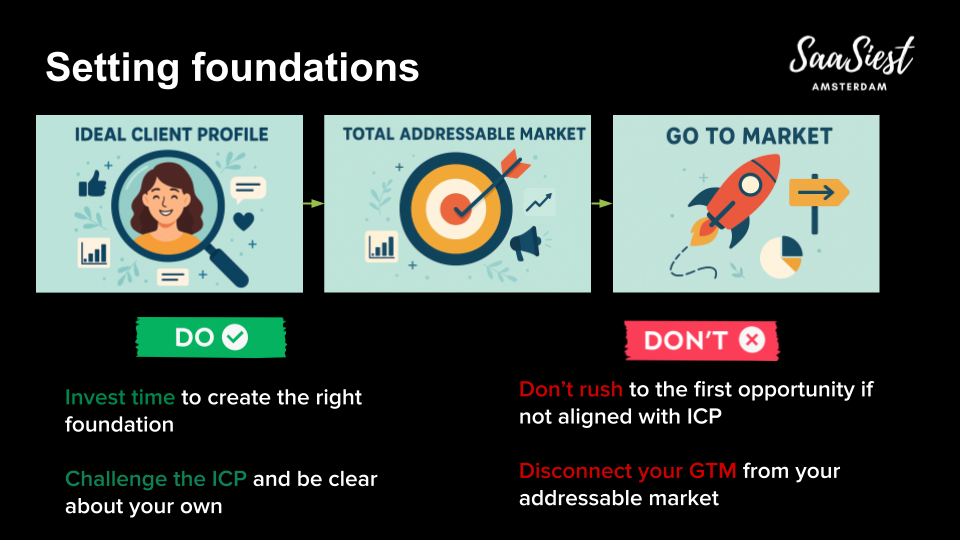
ICP → TAM → GTM: How to win with the right partners
The same discipline that drives ecosystem scale applies to one-to-one partnerships.
Benjamin’s framework is clean:
- ICP (Ideal Client Profile): Understand both your own and your partner’s ICP.
- If your customers don’t overlap, the partnership will fail before it starts.
- If your customers don’t overlap, the partnership will fail before it starts.
- TAM (Total Addressable Market): Identify the joint addressable market created by that overlap.
- The tighter it is, the easier it is to activate.
- The tighter it is, the easier it is to activate.
- GTM (Go-to-Market): Build specific, tactical plays for that shared TAM.
- Example: “Let’s target 10 luxury fashion brands in London—invite them to dinner instead of hosting a 2,000-person event.”
This shift from broad campaigns to micro-coordinated GTM is where partnerships stop being fluff and start driving real pipeline.
Ecosystem maturity checklist
Benjamin outlined what separates a fragile ecosystem from a resilient one:
Map partner types clearly — Tech, agency, system integrator, investor. Each plays a role in your value chain.
Adapt incentives by maturity — The metrics and rewards that work in early-stage won’t drive yield later.
Balance the RFY levers — Don’t chase partner count without productivity.
Invest in enablement — Partners can’t sell or integrate what they don’t understand.
Be patient — True ecosystem impact compounds over 2–3 years, not 2–3 months.
Stay humble — Ecosystems collapse when one side forgets it’s a two-way street.
Why this matters for every SaaS leader
AI might change how we code, market, and sell—but the real growth multiplier still comes from people and partnerships.
“At Shopify, we have 10,000 employees. But with 100,000 partners—each with teams of their own—that’s two million people working with us,” Benjamin said.
That’s the difference between speed and scale.
Speed comes from what your internal team can do.
Scale comes from what your ecosystem can make possible.
The takeaway
If you want to grow 40% a year without doubling your headcount, you need an ecosystem engine that compounds through reach, frequency, and yield.
Start by mapping your partners.
Align your incentives.
Design for mutual profit.
And never forget—the best ecosystems aren’t built on dependency.
They’re built on shared ambition.