

For years, SaaS companies have treated software as their biggest competitive advantage.
Build better features. Create a better user experience. Ship faster than everyone else. If your product were difficult enough to replicate, competitors would need years to catch up.
AI is beginning to change that assumption.
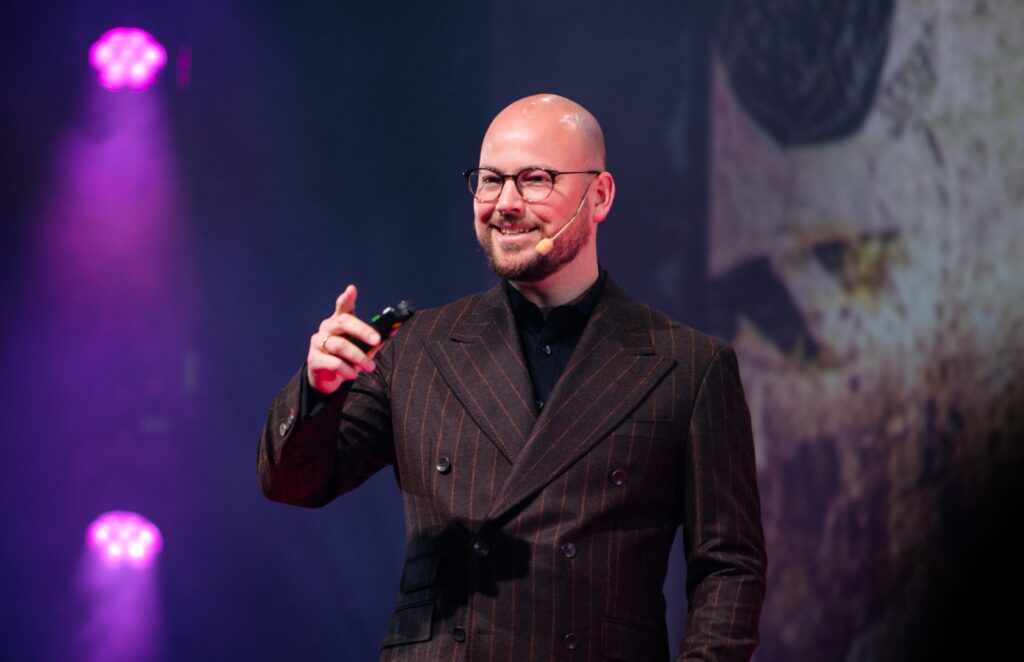
At SaaSiest 2026, Fabian Q. Veit, CEO of Make.com, argued that software itself is rapidly becoming cheaper to build. Features that once took months of engineering effort can increasingly be generated in days. Entire applications can be recreated surprisingly quickly. That doesn’t mean competition disappears, but it does mean that the source of competitive advantage is shifting.
The question for SaaS leaders is no longer, “How difficult is our product to build?”
It’s, “What can’t AI copy?”
Software Is Becoming Easier. Operating a Business Isn’t.
One of the strongest ideas from Fabian’s presentation was that many companies are focusing on the wrong moat.
For years, software businesses have talked about defensibility in terms of proprietary technology, unique features or network effects. Those things still matter, but if AI dramatically lowers the cost of producing software, then products alone become less defensible than they once were.
What AI can’t easily recreate is everything that happens after software ships.
Every customer implementation. Every production incident. Every feature request that revealed something unexpected. Every failed experiment. Every difficult trade-off between engineering, product and commercial teams.
Fabian described this accumulated operational knowledge as scar tissue.
It’s the collection of lessons a company earns by solving real customer problems over many years. Most of it isn’t documented. It lives inside thousands of product decisions, customer conversations and operational experiences that shape how a company works.
That experience becomes incredibly difficult to replicate, even if someone can reproduce the product itself.
The Companies That Scale Keep Rebuilding Themselves
Fabian has now helped scale two very different SaaS companies – first Celonis and now Make. One lesson has remained consistent throughout both journeys.
The operating model that gets a company to one stage of growth rarely gets it to the next.
As companies grow, it’s tempting to optimise what already exists. Tweak the sales process. Adjust pricing slightly. Add another layer of management. Improve the existing structure rather than replacing it.
Fabian argued that this instinct can become one of the biggest obstacles to growth.
Instead of continuously improving yesterday’s operating model, companies need to become comfortable tearing it down and rebuilding it. At Make, the go-to-market organisation has evolved almost every year. Sales motions, pricing, customer engagement models and team structures have all changed as the business entered new stages of growth.
Those weren’t signs that previous decisions had been wrong.
They were evidence that the company had outgrown them.
Culture Doesn’t Scale on Its Own
The same principle applies to culture.
In a company of thirty people, culture happens naturally. Everyone knows the founders. Everyone observes how decisions are made. Expectations spread through daily interactions rather than documentation.
Growth changes that.
As organisations move into the hundreds of employees, assumptions stop scaling. New hires can no longer absorb culture simply by sitting next to experienced colleagues. The behaviours that once felt obvious now need to be made explicit.
Fabian shared how Make recently documented a small set of operating principles that define how the company works. Not corporate values designed for posters on office walls, but practical behaviours that guide decision-making every day.
Ideas like embracing change, taking ownership, focusing on craftsmanship and practising radical candor became operating principles rather than unwritten expectations.
The objective wasn’t bureaucracy.
It was preserving what made the company successful while everything else continued evolving.
AI Makes Learning More Valuable Than Planning
Perhaps the most interesting part of Fabian’s talk wasn’t about technology at all.
It was about adaptability.
Every AI conversation eventually arrives at the same question: how do companies build a sustainable advantage when technology changes every few months?
Fabian’s answer wasn’t to predict the future more accurately.
It was to learn faster than everyone else.
Every company is experimenting with AI. New models appear constantly. New workflows emerge almost every week. The organisations that succeed won’t necessarily be those with the best initial strategy. They’ll be the ones willing to continuously discard old assumptions, test new approaches and rebuild parts of their business when circumstances change.
Execution, in that world, becomes less about following a fixed plan and more about increasing the speed at which the organisation learns.
Your Hardest Problems May Become Your Biggest Advantage
The final takeaway from Fabian’s session was surprisingly optimistic.
Many SaaS companies worry that AI will make their products easier to copy.
That concern is probably justified.
But copying software isn’t the same as copying a business.
Every difficult customer deployment. Every regulatory challenge. Every edge case. Every operational mistake the company has already learned from creates knowledge that competitors – and AI – simply don’t have.
That’s the scar tissue Fabian kept coming back to throughout the session.
For years, SaaS companies have treated those experiences as the cost of building software.
Increasingly, they may become one of the most valuable assets they own.
Because in a world where everyone can build products faster, the companies that win won’t necessarily have written the best code.
They’ll have learned the most from running it.