

For years, the SaaS industry has been obsessed with one thing: recurring software revenue. ARR is the metric investors celebrate, founders optimise for, and executives build their strategies around. Professional services, meanwhile, have often been treated as an inconvenient necessity, something required to get customers live but rarely considered central to the business model.
The conventional wisdom is familiar. Software scales. Services don’t. Software generates attractive margins. Services require people, hours and operational complexity. The ideal SaaS business, according to this thinking, should minimise its dependence on consulting, implementation and other human-intensive work.
But what if that assumption is becoming increasingly outdated?
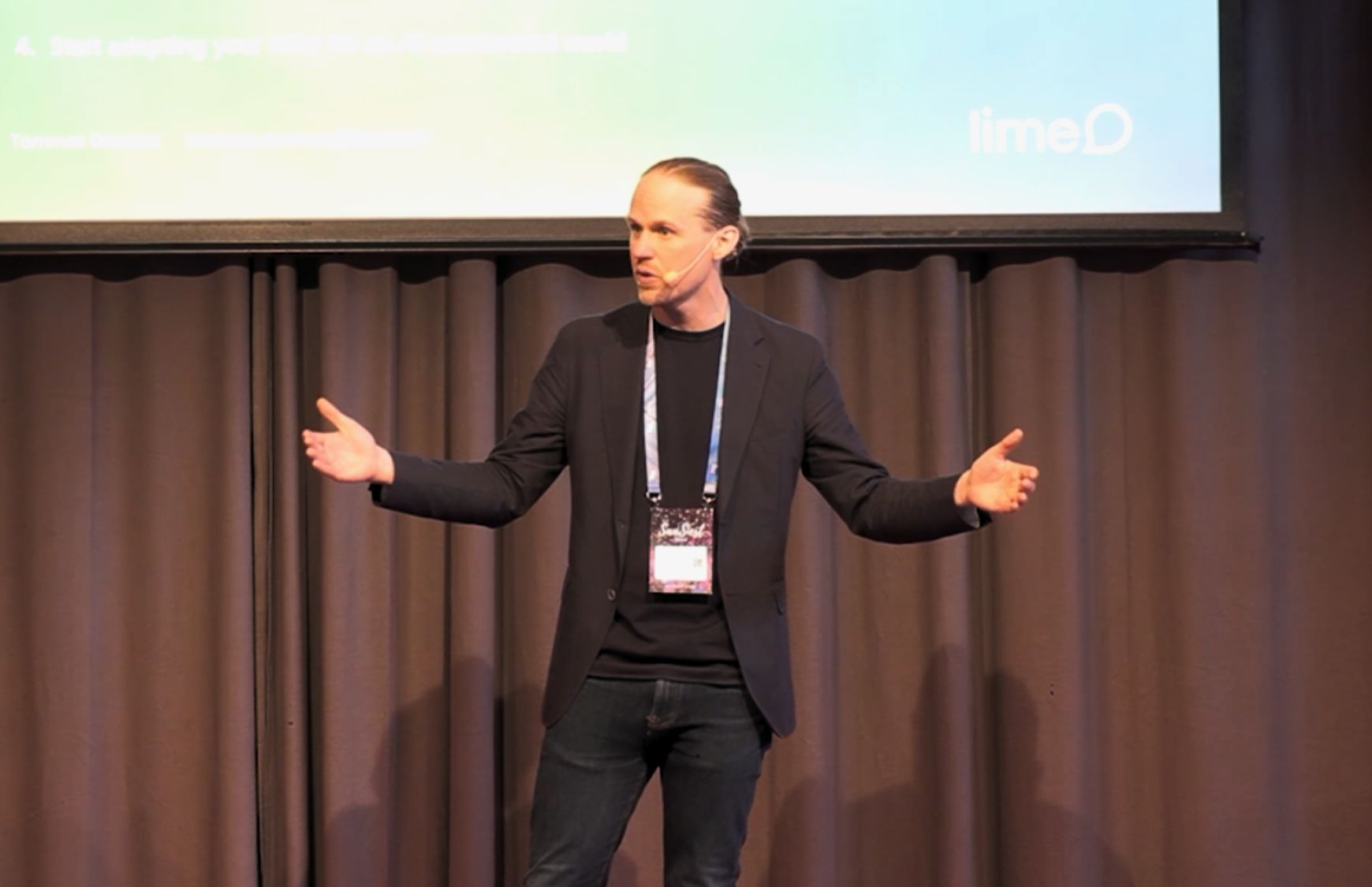
At SaaSiest 2026, Tommas Davoust, Group CEO at Lime Technologies, made the case for taking professional services much more seriously. Drawing on Lime’s experience building a substantial services business alongside its software offering, he argued that services can become a profitable revenue stream, strengthen customer relationships and improve retention.
And as AI makes software development faster and technical implementation more efficient, the strategic importance of human expertise might actually increase.
SaaS Has Been Undervaluing the Human Part of Software
The traditional argument against professional services is fundamentally about scalability. Every additional consultant represents another cost, and every project requires time that cannot be replicated as easily as a software subscription.
That makes services less attractive on paper than recurring software revenue. But it also overlooks an important reality: customers rarely buy software simply because they want access to technology.
They buy it because they want to achieve something.
A CRM platform isn’t valuable because it contains a database of contacts. It’s valuable because it helps a company improve its sales performance, manage customer relationships and operate more effectively. Achieving those outcomes often requires much more than providing access to the product.
There are integrations to configure, processes to redesign, employees to train and behaviours to change. The software may enable the transformation, but the implementation determines whether the promised value becomes reality.
That’s the opportunity Tommas highlighted. Instead of viewing professional services as a cost attached to the software business, SaaS companies can treat them as a strategic capability that helps customers achieve the outcomes they purchased the product for in the first place.
At Lime Technologies, this philosophy has become a meaningful part of the business. Tommas described a company with roughly 70% of its revenue coming from software and 30% from professional services, with annual services revenue exceeding SEK 200 million.
He also pointed to Lime’s long-term financial performance: approximately 18% average annual growth and a 25% average EBITA margin over 25 years, achieved without raising external capital.
Those figures don’t prove that every SaaS company should build a services organisation. But they challenge the assumption that a substantial professional services business is incompatible with profitable software growth.
Professional Services Should Make Your Software More Valuable
The most important distinction in Lime’s approach is that professional services aren’t intended to become an independent consulting business.
They’re designed to make the software business stronger.
Tommas described Lime’s strategy as building professional services into a profitable enabler of its software. That means the services organisation has to generate value and operate profitably, but its ultimate purpose is to help customers succeed with Lime’s products.
This creates a different set of priorities from those of a traditional consulting firm.
A consulting business might pursue any attractive project that fits its expertise. Lime deliberately limits its professional services to work connected to its own software. Customers may ask its consultants to help with other challenges, but the company maintains a clear boundary around what it will deliver.
That discipline matters because services businesses can easily drift away from their original purpose. A few profitable custom projects can become a growing collection of unrelated engagements, consuming resources and making the organisation increasingly difficult to scale.
By keeping professional services connected to the product, Lime creates a more coherent business model. Implementation, training, advisory and behavioural change all contribute to the same objective: helping customers realise more value from the software they’ve purchased.
It also changes how the company positions itself commercially. Rather than selling software and leaving customers to figure out the rest, Lime can present itself as a partner in achieving a business outcome.
Tommas even described offering customers a 100% success guarantee, with money back if they feel an implementation hasn’t worked.
That’s a very different promise from simply providing access to a software platform.
The Real Value Might Be Retention, Not Services Revenue
Additional revenue is the most obvious reason to introduce professional services. But Tommas argued that the more interesting benefit may be what services do for the recurring software business.
At Lime, the company has observed a direct correlation between the number of consulting hours customers purchase and how long those customers remain.
That doesn’t necessarily mean consulting hours alone cause higher retention. Customers who are more committed to the platform may naturally invest more in services. But the relationship points to something strategically important: deeper customer engagement and better implementation can reinforce the value of the underlying software.
A customer that has successfully integrated a product into its workflows, trained its employees and adapted its processes is in a very different position from one that simply purchased a subscription.
The first has invested in making the technology work. The second may still be struggling to justify the purchase.
Professional services can help bridge that gap.
This is especially relevant for SaaS companies selling complex products into organisations where adoption requires operational change. Customer success teams can support relationships and encourage usage, but there are situations where customers need hands-on expertise to implement new processes, build integrations or change how people work.
Those activities may generate services revenue, but their longer-term value can come from making the software more useful and harder to replace.
In that sense, professional services aren’t necessarily competing with ARR for strategic importance.
They can be one of the mechanisms that protect it.
Don’t Build a Services Business Unless It Deserves to Exist
Despite his enthusiasm for professional services, Tommas wasn’t suggesting that every SaaS company should introduce them.
His first recommendation was to establish whether the business actually has a reason to offer services.
That begins with two questions. Can the company create meaningful additional value for customers through services? And are those customers willing and able to pay for that value?
If the answer to either question is no, professional services may simply introduce complexity without improving the business.
Tommas also offered a practical rule of thumb: consider whether services could eventually represent more than 15% of revenue. If the opportunity is substantially smaller, he argued, the company may struggle to give the business enough attention and resources to operate it properly.
It’s not a universal threshold, but it captures an important principle. A services organisation needs management attention, commercial ownership, delivery processes and performance measurement. Treating it as an occasional side activity is unlikely to produce consistent results.
For companies that do see a meaningful opportunity, Tommas outlined five areas that need to work together: strategy, offering, sales, delivery and measurement.
The sequence matters because each part depends on the others. A strong service offering won’t succeed if the sales organisation doesn’t understand how to sell it. A motivated sales team can create problems if delivery quality is inconsistent. And even an effective delivery organisation can become unprofitable without reliable measurement.
The challenge isn’t simply hiring consultants.
It’s building a business around them.
Your Sales Team Can Make or Break the Entire Model
One of the more revealing parts of Tommas’s presentation concerned the relationship between professional services and the sales organisation.
SaaS sales teams are typically rewarded for selling software. Their compensation structures, performance targets and commercial instincts are built around recurring revenue.
That creates a potential conflict when professional services enter the picture.
A salesperson trying to close a valuable software contract may view implementation or consulting fees as negotiable extras. If discounting those services helps secure the ARR, giving them away can seem like an easy decision.
But from the perspective of the services organisation, that behaviour undermines profitability and trains customers to expect expertise for free.
Lime initially addressed this problem with an unusually strict rule: salespeople weren’t allowed to negotiate professional services hours.
Tommas acknowledged that the restriction might seem commercially inflexible, but it served a purpose. It established that services had real value and couldn’t simply be sacrificed to close a software deal.
The company has since become more flexible, but the early discipline helped establish a different commercial mindset.
Tommas also emphasised the importance of getting sales managers genuinely committed to the model. He described helping another company establish professional services, only to discover that the sales manager wasn’t truly supportive of the change. Despite other parts of the strategy being in place, that lack of commitment became a barrier.
The lesson is that professional services can’t succeed as an isolated initiative owned by consultants or operations.
Sales leadership has to believe in it.
And sometimes the most effective way to build that belief is to start with one successful salesperson. When Lime introduced change management services, one of its strongest sales representatives embraced the offering. His success helped demonstrate its value to colleagues, eventually making it part of the wider sales organisation’s approach.
Rather than trying to persuade everyone through presentations and internal messaging, the company allowed commercial results to build momentum.
Delivery Quality Is Where the Strategy Becomes Real
Selling professional services is one challenge. Delivering them consistently is another.
Tommas was candid about Lime’s earlier approach. Consultants were sent out to customers with relatively limited standardisation, and the company hoped that individual expertise would produce good results.
Unsurprisingly, delivery quality varied.
The problem with that approach is that a services business becomes dependent on individual consultants rather than repeatable organisational capabilities. Some customers receive excellent experiences, while others encounter inconsistent processes, unclear expectations or disappointing outcomes.
That inconsistency becomes particularly dangerous when services are supposed to strengthen the software relationship.
Lime responded by developing more structured delivery processes, including separate playbooks for new and existing customers, supported by clearer quality assurance.
The company also defined what consultants should actually do. Its professional services organisation handles implementation and customisation, but consultants can also contribute to complex support cases and commercial opportunities.
That creates a broader role than simply completing technical projects.
In the discussion following the presentation, Tommas explained that Lime works with different consulting profiles, including technical specialists, project management capabilities and people focused on management consulting and behavioural change.
That combination reflects the reality that successful software adoption is rarely a purely technical exercise.
A technically flawless implementation can still fail commercially if employees don’t adopt the product or if the organisation doesn’t change how it works.
The most valuable professional services teams therefore need to understand both the technology and the business outcomes it is supposed to enable.
AI Is Changing What Customers Should Pay For
AI introduces an uncomfortable question for traditional professional services businesses.
What happens when work that previously required ten hours can suddenly be completed in two?
Or two minutes?
For a business charging primarily by the hour, greater efficiency can create a direct revenue problem. The faster consultants complete technical work, the fewer hours they can bill.
Tommas argued that SaaS companies need to make conscious decisions about how they respond.
They can pass the efficiency gains directly to customers through lower prices. They can redesign their packages around the value delivered rather than the time required. Or they can create new offerings that reflect the changing needs of their customers.
What they shouldn’t do is ignore the shift.
At Lime, the company is already seeing routine technical tasks and simpler implementation work become less central to the services organisation. In response, it is moving towards more strategic advisory work and services focused on helping customers change how they operate.
That transition may become increasingly important across the SaaS industry.
As AI makes technical execution faster and more accessible, the scarcity of technical implementation expertise may decline. But understanding a customer’s organisation, identifying the right problems and helping people adopt new ways of working could remain difficult to automate.
The value of professional services may therefore shift away from completing tasks and towards helping customers achieve results.
And that creates an opportunity for companies willing to rethink how they package, price and deliver expertise.
The Next SaaS Moat Might Be the Relationship
There’s another reason professional services could become more strategically important in the AI era.
Software itself is becoming easier to build.
Capabilities that once required substantial engineering teams can increasingly be developed more quickly with AI-assisted tools. Competitors can replicate features faster, and customers may find it easier to evaluate alternative solutions.
That raises an uncomfortable question for SaaS companies: if software functionality becomes less differentiated, what will make customers stay?
Tommas suggested that human relationships could become part of the answer.
At Lime, the professional services organisation spends significant time working directly with customers. Consultants understand their processes, challenges and ambitions. They help implement changes and see how the software performs in real operating environments.
That creates a relationship that goes beyond a subscription agreement.
Lime has also made a deliberate decision to deliver its professional services internally rather than relying on external implementation partners. Tommas acknowledged that this limits how quickly the business can scale compared with a partner-led model.
But he argued that direct delivery offers advantages in quality, customer relationships, feedback and control over the experience.
For a company that views services as a way to strengthen its software business, owning that interaction becomes strategically valuable.
It also creates a direct feedback loop between customers and the organisation building the product.
As software becomes more abundant, that understanding of the customer may become harder for competitors to reproduce than the functionality itself.
Profitability Requires More Than Good Consultants
A services business can generate substantial revenue and still struggle financially if its operations aren’t managed carefully.
Consultant utilisation, pricing, project delivery, discounting and staffing all influence profitability. Unlike software revenue, services revenue is closely connected to the availability and productivity of people.
That’s why Tommas placed significant emphasis on measurement.
Lime tracks its consulting operations closely, with consultants logging their time daily and management monitoring performance across individuals, teams, offices, countries and the wider organisation.
The purpose isn’t simply to produce reports. It’s to identify problems early enough to act.
If the organisation knows the delivery pace required to meet its financial targets, it can compare current performance with that expectation and make adjustments before the month or quarter has already ended.
Tommas also described using AI-generated reports to monitor trends among major customers, including changes in their consulting activity.
In the Q&A, he suggested that a professional services gross margin between 30% and 50% is a reasonable target, with profitability remaining an explicit requirement rather than an optional benefit.
That financial discipline is essential to the broader strategy.
Professional services can’t be a profitable enabler of software if they’re routinely discounted, delivered inefficiently or managed without reliable data.
The business needs to create customer value while standing on its own operational foundations.
Stop Treating Services as a Necessary Evil
The SaaS industry’s preference for recurring software revenue is understandable. Subscription models offer scalability, predictability and attractive economics when executed well.
But that doesn’t mean everything surrounding the software should be minimised.
For the right companies, professional services can create an additional revenue stream, improve implementation quality, deepen customer relationships and support long-term retention. They can also provide something increasingly valuable in a world of AI-generated software: direct human expertise that helps customers turn technology into measurable business outcomes.
Tommas’s experience at Lime Technologies offers a counterpoint to the assumption that professional services are inherently undesirable. The company has built a substantial services operation while maintaining a long-term focus on profitable software growth.
The important lesson isn’t that every SaaS business should aim for 30% services revenue. It’s that professional services deserve to be evaluated strategically rather than dismissed automatically.
If customers need expertise to realise the full value of a product, that expertise may be worth packaging, selling and delivering exceptionally well.
And if AI continues to make software easier to build, the relationships and operational knowledge created through that work could become even more valuable.
The next great SaaS competitive advantage might not be another feature, another AI agent or another product release. It might be the people who make sure the software actually works for the customer.