
If you’ve listened to enough AI discussions over the past year, you’ve probably heard the same prediction repeated over and over again.
Companies will become smaller.
Teams will shrink.
AI will replace large parts of today’s workforce.
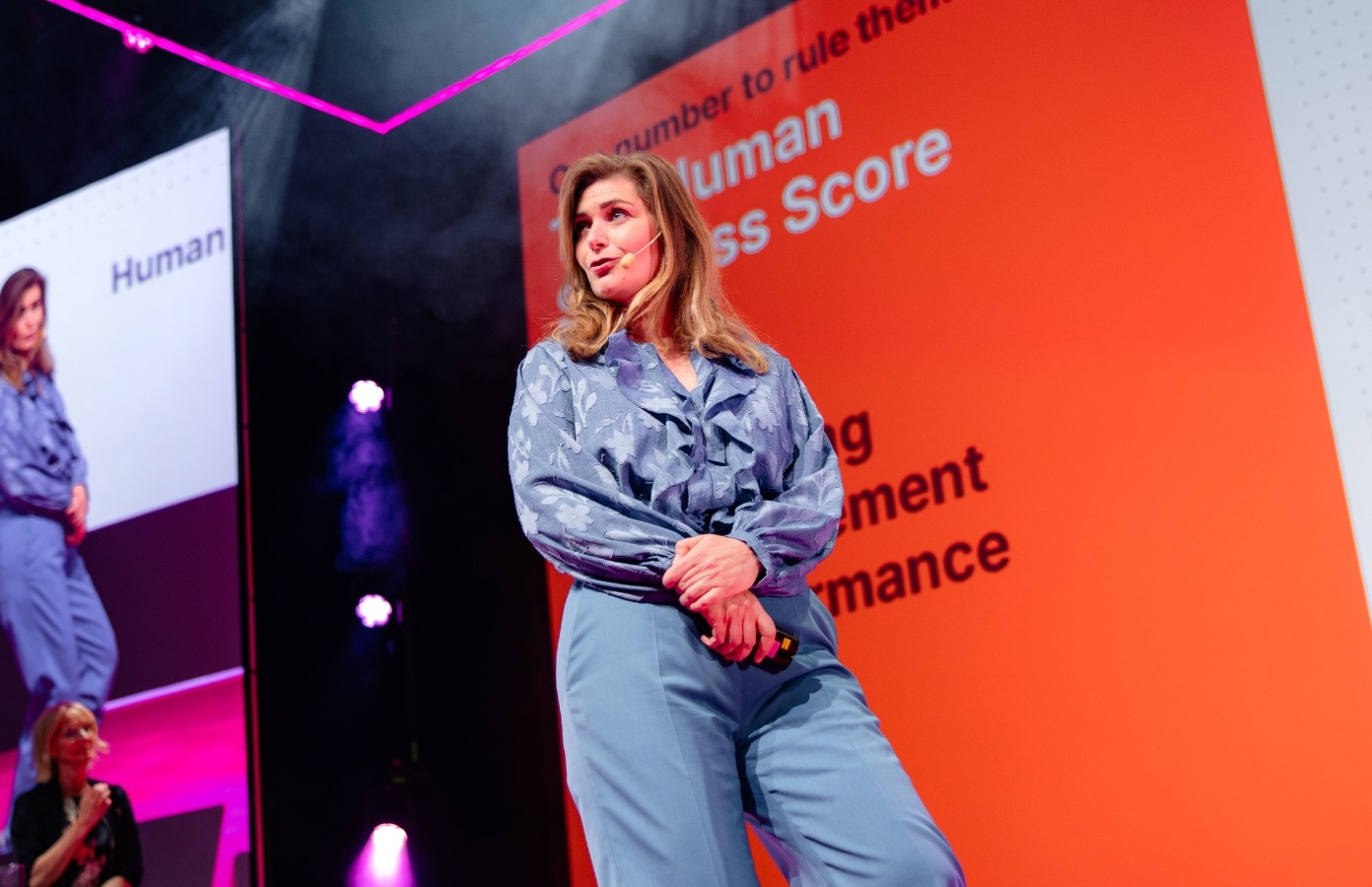
At SaaSiest 2026, Nina Elisabeth Carøe, Chief Human Success Officer at Zensai, offered a different perspective.
The companies that outperform over the next decade won’t necessarily be the ones that employ the fewest people. They’ll be the ones who help every employee create dramatically more value.
That might sound like a subtle distinction.
It’s actually a completely different operating model.
AI Doesn’t Fix Broken Organisations
One of the biggest mistakes companies are making right now is treating AI as another piece of software.
Roll out a new tool.
Train employees.
Wait for productivity to increase.
According to Nina, that’s not what’s happening.
AI doesn’t simply automate work. It exposes how organisations already work. If communication is poor, AI makes the confusion scale faster. If priorities are unclear, AI accelerates work in multiple directions at once. If managers struggle to coach people today, giving everyone better technology won’t suddenly solve that problem.
AI acts less like a productivity tool and more like a multiplier.
It amplifies both strengths and weaknesses.
That’s why so many companies report higher individual productivity while struggling to demonstrate meaningful business impact. Employees may be using AI every day, but if the organisation itself hasn’t changed, those gains rarely translate into better outcomes.
Productivity Isn’t the Same as Performance
This gap between activity and results became one of the central themes of Nina’s session.
Most organisations can already point to examples where employees complete tasks faster with AI. Documents are written more quickly. Research takes less time. Code is generated in seconds.
But faster work doesn’t automatically create a better business.
Nina referenced research showing that much of AI-generated work still needs to be reviewed, edited or rewritten before it can actually be used. The result is that many employees aren’t necessarily working less. They’re simply spending their time differently.
That creates a challenge for leadership.
If AI saves two hours a day, what should people actually do with those two hours?
Without a clear answer, productivity gains remain isolated improvements instead of becoming an organisational advantage.
Fear Is the Fastest Way to Slow AI Adoption
One observation from the session felt particularly relevant as more companies announce AI-driven restructurings.
If employees believe AI exists primarily to replace them, they have very little incentive to embrace it.
Nina argued that organisations need to create trust before they can create adoption.
People need to believe that AI helps them become more valuable, not more disposable. Otherwise, every new AI initiative is interpreted as another step toward redundancy rather than an opportunity to improve how work gets done.
That trust becomes a competitive advantage.
Companies that successfully position AI as a tool for increasing employee capability will likely see much faster adoption than organisations where AI is introduced primarily as a cost-cutting exercise.
Boards Need a New Metric
One of the more interesting parts of Nina’s presentation wasn’t aimed at HR leaders.
It was aimed at CFOs.
Historically, people functions have measured engagement, learning and employee satisfaction separately from financial performance. Those metrics often struggled to gain attention in boardrooms because they felt disconnected from business outcomes.
Nina argued that this separation no longer works.
Instead of talking about engagement scores in isolation, organisations need to connect people directly to commercial performance. Learning becomes AI adoption. Engagement becomes retention risk and execution capability. Performance becomes revenue per employee.
The conversation shifts from people initiatives to business outcomes.
That’s a language every leadership team understands.
AI Transformation Isn’t an IT Project
Perhaps the biggest organisational lesson from the session was that becoming AI-first cannot be delegated to a single department.
Technology teams obviously play a critical role.
But so does finance.
And leadership.
And people operations.
Nina described how Zensai created a cross-functional AI transformation office bringing together technology, finance and people leadership under one shared objective: increasing ARR per employee.
That choice is significant.
The goal isn’t simply reducing costs or replacing people.
It’s increasing the amount of value every person can create with the help of AI.
Those are very different ambitions.
The Winners Will Build Better Humans, Not Just Better AI
The final message from Nina’s talk stood in contrast to many of the conversations happening across the AI industry today.
Every company will have access to powerful AI models.
Every company will automate more work.
Technology itself is unlikely to become the long-term differentiator.
People will.
Not because humans outperform AI at every task, but because organisations that help people work effectively alongside AI will move faster, adapt quicker and create more value over time.
The companies that win won’t simply deploy better technology.
They’ll build operating models where people, AI and strategy reinforce each other.
Because in the end, AI doesn’t replace the need for great organisations.
It raises the standard for what great organisations look like.