


Moving upmarket looks incredibly attractive on a SaaS spreadsheet.
Larger customers. Higher ACVs. Bigger expansion opportunities. Fewer deals required to hit the same revenue target. For a company that has already found success in SMB or mid-market, enterprise can look like the obvious next step.
Just find bigger companies and sell them the same thing for more money.
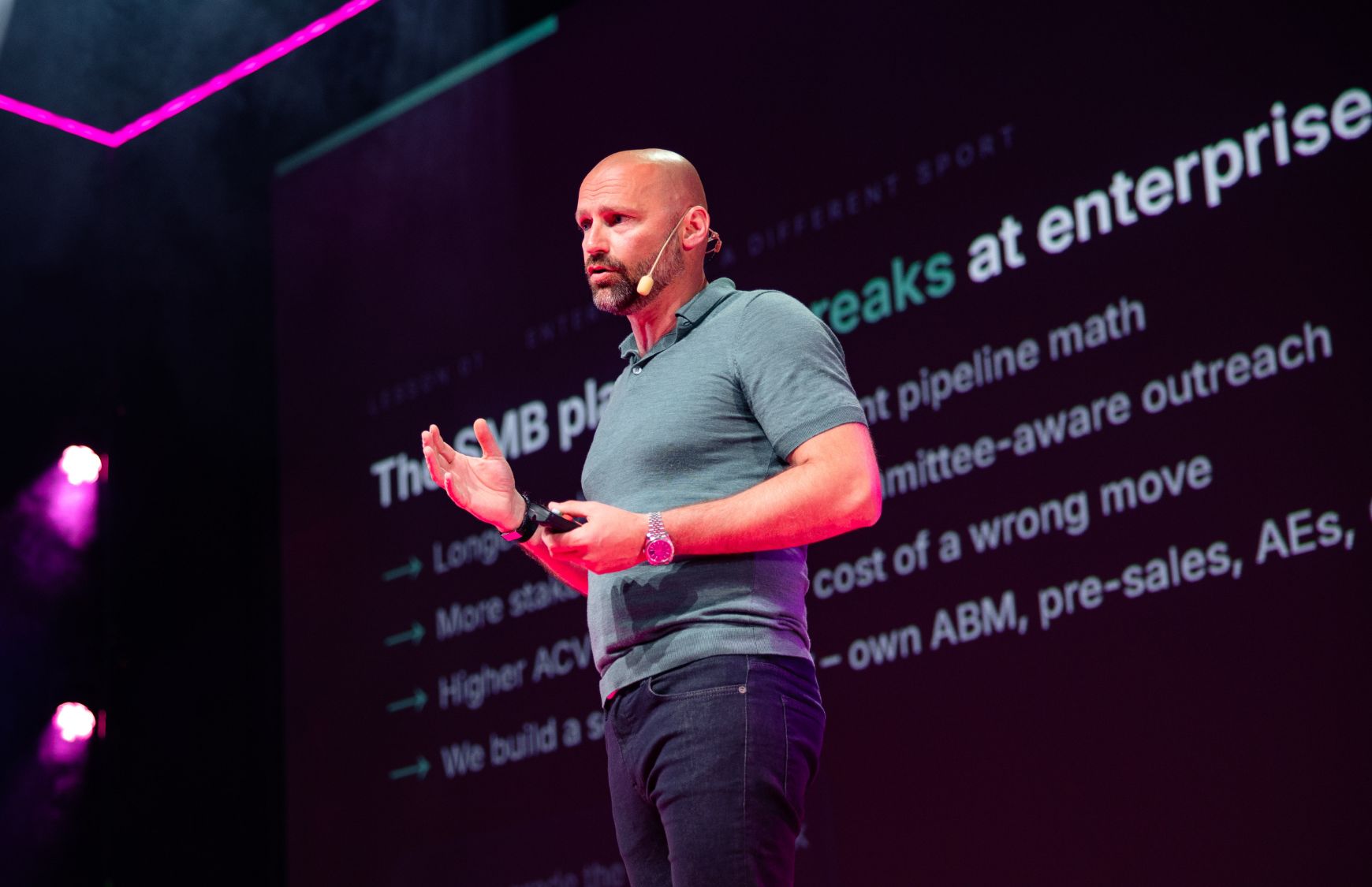
Tim van Hattem, Chief Revenue Officer at Sana Commerce, argues that this is exactly where companies get into trouble.
Over the past seven years, Sana Commerce has increased its average monthly recurring revenue from around €1,200 to €5,500. Enterprise deals now typically sit between €10,000 and €25,000 in monthly recurring revenue, with some considerably larger.
The product didn’t fundamentally change.
The go-to-market motion did.
Because enterprise isn’t simply a bigger version of SMB.
It’s a different sport.
Bigger Customers Require a Different Machine
The first mistake companies make when moving upmarket is trying to upgrade the playbook they already have.
Tim learned that doesn’t work.
At Sana Commerce, an SMB sales cycle typically lasts between three and six months. Enterprise can take anywhere from nine to eighteen months. There are more stakeholders, more internal resources involved and significantly more money at risk when a deal falls apart.
The role of the salesperson changes too.
In SMB, a great salesperson can sometimes carry the deal. In enterprise, Tim described the salesperson more like the conductor of an orchestra. Pre-sales, marketing, legal, Customer Success and other specialists all need to contribute at the right moment.
Meanwhile, the buyer might have eight or ten stakeholders, each with different objectives and concerns.
That’s why Sana didn’t simply retrain its existing team. It built a separate enterprise motion with dedicated AEs, CSMs, marketing resources and pre-sales expertise.
Moving upmarket wasn’t an iteration.
It required a new machine.
Stop Trying to Convince Customers That Now Is the Time
One sentence from a prospect changed how Tim thought about enterprise sales.
“It’s on our radar, but we have other priorities.”
The natural response from a SaaS company is to overcome that objection. Send more emails. Create urgency. Explain the cost of waiting. Keep nurturing until the prospect finally understands why they should act now.
But eventually Tim came to a different conclusion.
Sana’s ability to change the internal priorities of a large enterprise was relatively small.
The better strategy was to understand when those priorities were already changing.
That distinction completely changes outbound.
Instead of asking, “Who should we contact?” the question becomes, “When should we contact them?”
Enterprise Outbound Is a Timing Game
Traditional outbound works reasonably well when you have tens of thousands of potential accounts.
Build a list. Create sequences. Personalise where possible. Increase activity and convert a percentage of the market into opportunities.
Enterprise gives you far fewer chances.
If your addressable market contains 500 companies rather than 50,000, repeatedly contacting accounts at the wrong moment becomes expensive. You aren’t just wasting an email.
You’re potentially damaging a relationship with a meaningful percentage of your market.
Sana therefore shifted its approach from lists to signals.
A signal is evidence that something is changing inside an account which could create a window of opportunity.
For Sana, which sells B2B e-commerce software primarily to large manufacturers and OEMs, one example came from major industry events. Manufacturers increasingly wanted to demonstrate their digital capabilities at those events, including how customers could buy online.
If an important industry event was approaching, that could indicate that certain companies might soon prioritise their digital commerce experience.
The signal didn’t mean they were automatically ready to buy.
But it told Sana when to start paying attention.
One Signal Isn’t Enough
The challenge is that enterprise buying signals rarely arrive neatly packaged inside your CRM.
They’re scattered everywhere.
Sales conversations. Emails. CRM notes. Marketing engagement. Company announcements. Events. Hiring. Technology changes. Information sitting in someone’s head.
The opportunity comes from connecting them.
Tim described how Sana began analysing closed-won deals to understand which signals appeared before customers entered an active buying process. Rather than looking for one perfect trigger, the team looked for combinations of signals that repeatedly appeared together.
That’s an important distinction.
One signal is interesting.
Several signals together can indicate intent.
AI has made analysing those patterns considerably easier. Companies now have transcripts from sales calls, CRM data, emails and marketing intelligence that can be analysed at a scale that would previously have been difficult.
But technology doesn’t solve the fundamental problem.
Someone still needs to decide which signals matter and what the organisation should do when they appear.
Your Product Has to Move Upmarket Too
There was another lesson Tim admitted Sana learned the hard way.
The company moved its go-to-market upmarket before its product was fully ready.
Enterprise customers don’t simply expect to pay more for the same experience. They bring different requirements around security, performance, reliability and implementation.
If sales starts winning those conversations before Product is ready to deliver on them, the roadmap immediately goes into catch-up mode.
Instead of building ahead of the market, Product spends its time closing gaps created by deals already being pursued.
Tim’s advice was simple: product readiness and go-to-market readiness have to move together.
Otherwise, moving upmarket can generate impressive pipeline while simultaneously creating customers you aren’t ready to serve.
AI Won’t Fix a GTM Nobody Owns
Signals sound like a technology problem.
Tim argued that they’re actually an ownership problem.
Marketing sees one part of the account. Sales sees another. Customer Success has its own information. Product may understand another piece entirely. AI can analyse all of it, but if nobody owns the combined picture, the organisation still ends up with disconnected signals.
Sana eventually put one person in charge of the entire motion, from data quality and signal identification to cross-functional coordination.
That ownership matters because enterprise GTM depends on different teams responding together.
Knowing that an account is entering a buying window is useful.
Having Sales, Marketing and the wider revenue organisation respond coherently to that window is much more valuable.
Moving Upmarket Means Trading Volume for Precision
The appeal of enterprise SaaS is obvious.
Sana Commerce more than quadrupled its average deal size during its journey upmarket.
But those economics come with a very different operating model.
There are fewer accounts to pursue. Sales cycles are longer. More stakeholders influence every purchase. Losing an opportunity costs more. Product expectations rise. Timing becomes more important and mistakes become more expensive.
That means the companies that successfully move upmarket aren’t simply better at selling expensive contracts.
They become better at knowing when to sell, who needs to be involved and whether the organisation is actually ready to deliver.
Tim’s final description captures the shift well.
Enterprise GTM stops being a volume game.
It becomes a precision game.
And if you’re trying to play that game with the same machine that made you successful in SMB, increasing your prices is probably the least of your problems.