


For years, growth in SaaS followed the same path: SEO, ads, events, and outbound.
It worked – until it didn’t.
Algorithms changed. Ad costs rose. And the same companies that once dominated search began seeing traffic collapse overnight.
Mike Nelson, co-founder of Really Good Emails and now leading growth at Beefree, saw it firsthand.
“Three brands I worked with lost almost all of their SEO traffic in just 16 months.”
The problem wasn’t poor execution. It was overreliance on channels they didn’t own.
At Really Good Emails, Mike took a different approach – one that grew a 400,000-member community and 250,000 newsletter subscribers, with a team of just four people spending a few hours a week.
His secret: treat community as your go-to-market engine, not your afterthought.
Here’s how he built a global brand on connection, not clicks.
From panic to purpose: why community compounds
Mike’s defining story isn’t about growth hacks or funnels – it’s about his daughter.
When she went missing one afternoon, neighbors launched drones, knocked on doors, and formed search groups within minutes. She was found safe, but the moment revealed something bigger.
“That’s what a real community does. They act because they care. They move faster than you ever could alone.”
That same human instinct to help, when transferred into how you build a brand, becomes your most defensible moat.
At Really Good Emails, that meant prioritising trust and belonging over transactions.
The result?
Brand traffic up 200%, all driven by people searching directly for the name, not generic terms.
Step 1: Build a place, not a pitch
Community starts with a destination, somewhere people go for themselves, not for you.
When Mike worked at Lonely Planet, he discovered the “Thorn Tree,” an old tree in Namibia where travellers left handwritten notes about routes, hostels, and safety tips. The founders turned that idea into an online forum that became the internet’s first travel community.
The lesson stuck.
“If you build a place people can use – not a pitch, they’ll come back. And they’ll bring others.”
That’s how Really Good Emails was born: a destination to find, share, and learn from the best email designs on the web. Marketers submit their own work, get featured, and share the recognition, creating a loop of contribution and reward.
Takeaway for operators:
Audit your website. If every tab leads to a demo, you have a pitch deck, not a place.
Ask:
- Where can someone get real value without logging in?
- What resource could we create that’s worth bookmarking?
- What can we give away that earns trust before any transaction?
Examples include template libraries, teardown hubs, or research repositories. When you build something useful outside your product, you pull people in who want to stay.
Step 2: Trust is louder than trumpets
Big brands love billboards. Mike learned that the hard way.
At VTEX, he once helped launch a million-dollar Times Square ad during their IPO. The CEO was thrilled. Passersby? Unmoved.
“It was the worst ad of my career. No one cared. It was all trumpet, no trust.”
The opposite of that billboard moment is what Mike calls one-to-one growth – direct, human outreach that compounds.
Every week, he personally contacts a handful of new subscribers or creators. He thanks them, asks about their work, and invites them to share the site with one colleague.
No automation. No AI agents. Just real people talking.
And it works. In several cases, one message sparked 50+ new members from the same company.
Try this:
Pick five new subscribers a week. Send each a 60-second note. Mention something real, a city, a post, a shared challenge – and ask them to spread the word.
It’s slow at first, but trust compounds faster than paid clicks ever could.
“Attention can be bought. Trust has to be earned – and it multiplies.”
Step 3: Elevate distinct voices, not echo chambers
Communities thrive when people see themselves reflected, not just the “logo brands.”
To keep the Really Good Emails community fresh, Mike looks for the Barneys: people who speak differently.
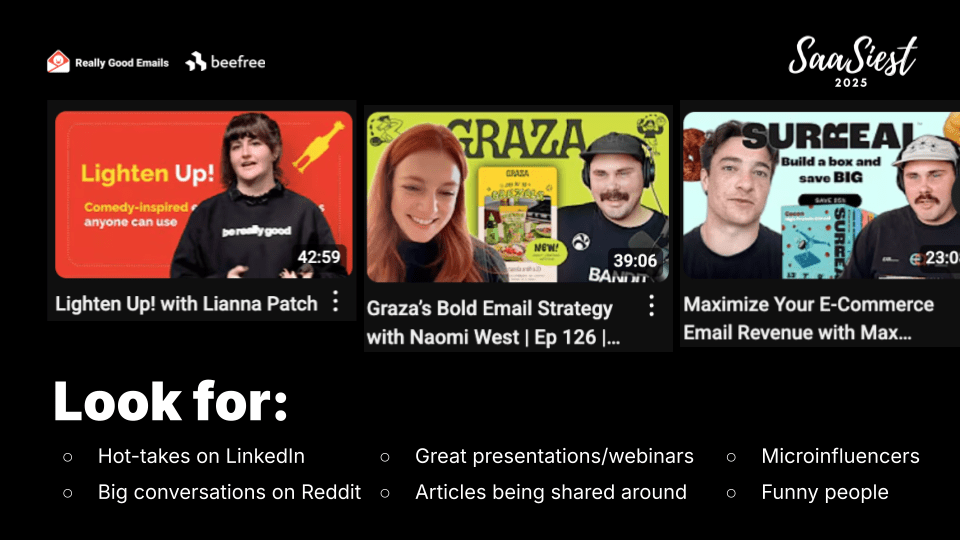
The story of Barney, a parrot famous for swearing at priests and businessmen, went viral because it broke the norm. Similarly, Mike scouts people with memorable voices in LinkedIn threads, Slack channels, and Reddit communities.
“It’s not about the biggest brand. It’s about the person with a sharp, funny, or brutally honest perspective.”
He interviews those creators, turns their comments into articles or videos, and lets them share with their own networks. It’s ego fuel for them and organic reach for you.
Your play:
- Identify five community members with original takes.
- Interview or co-create content with them.
- Publish and tag them everywhere.
The result? Authentic content that travels, because people share what they help create.
Step 4: Show up, don’t show off
Community collapses when it smells self-interest.
After the pandemic boom, Really Good Emails tried to monetise their Unspam event series. They expanded too fast, added sponsors, and lost the energy that made the early events great.
“The content was fine. The vibe was gone. It felt like we were performing, not participating.”
The fix was simple but hard: refocus every event and initiative on value for users first, revenue second.
When you do that, reciprocity follows naturally. People trust brands that give more than they take.
Ask your team:
- What’s one recurring thing we can do that helps our users win, even if it doesn’t drive immediate revenue?
It could be:
- A teardown series
- A job board curated by humans
- Monthly roundtables
- Public datasets or templates
Show up consistently. Make it useful. Don’t make it about you.
Step 5: Design for generosity, not perfection
Mike and his three co-founders built Really Good Emails on two to three hours a week. They didn’t scale with headcount; they scaled with focus.
The growth engine was simple:
- A searchable destination for the community
- Weekly personal outreach to new subscribers
- Regular spotlights on real users
- One recurring act of generosity
Those four motions, done consistently, are what built a multimillion-dollar acquisition.
And they’re free.
The takeaway
The next wave of GTM isn’t built on ads or algorithms. It’s built on belonging.
“You can always get attention. But trust – that’s what compounds.”
If your playbook feels stuck, start here:
- Build a place, not a pitch.
- Earn trust through direct connection.
- Elevate real voices, not corporate ones.
- Show up for your users before they show up for you.
Community isn’t fluffy. It’s your most scalable moat.
Watch Mike Nelson’s full session from SaaSiest 2025 here: https://saasiest.com/the-gtm-shortcut-we-didnt-see-coming/