




For years, SaaS pricing was relatively straightforward.
Build software, charge a subscription, grow adoption, and expand accounts over time. While companies experimented with different packaging models, the underlying economics remained fairly predictable. More customers and more product usage generally translated into more revenue.
AI is beginning to break that relationship.
At SaaSiest Malmö, Emil Eriksson, Chief Product Officer at Digital Route, shared the story of how his own company discovered this firsthand. The irony was hard to miss. Digital Route has spent more than 25 years helping some of the world’s largest enterprises manage usage data, billing, and monetization. If any company should understand usage-based business models, it should be them.
Yet despite working in the very industry that enables modern pricing models, they found themselves facing a problem many SaaS companies are now encountering.
Their products evolved faster than their pricing.
When Growth Stops Translating Into Revenue
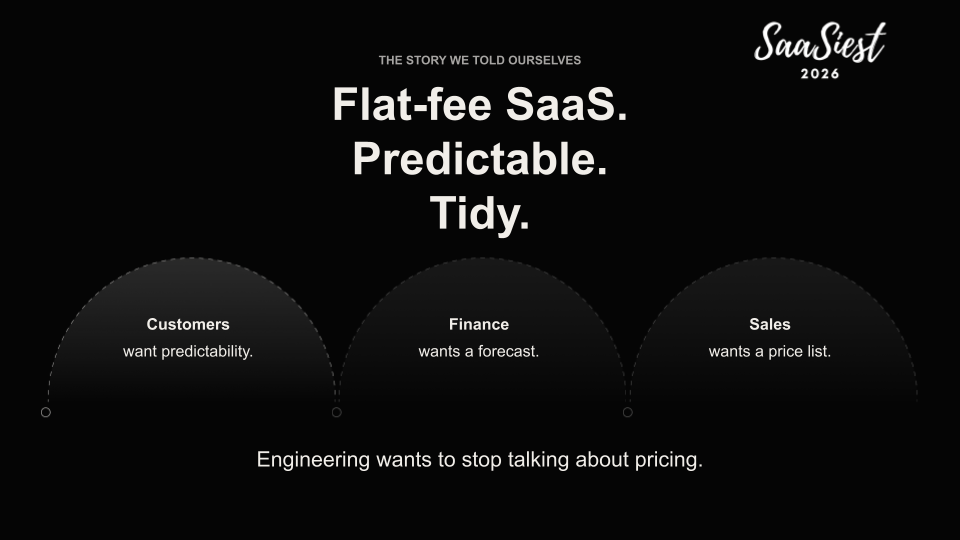
Like many enterprise software companies, Digital Route operated on a flat-fee pricing model. Customers appreciated the predictability. Finance teams could forecast revenue accurately. Sales teams avoided complicated pricing discussions during procurement processes.
For years, the model worked.
Then AI entered the picture.
As Digital Route introduced AI-powered capabilities, customer behavior changed almost immediately. Adoption increased. Customers processed more data. Workloads expanded. Engagement with the product grew significantly.
On the surface, these looked like positive signals. Product teams were seeing increased usage, customers were getting more value from the platform, and retention remained strong.
The problem was that none of it showed up in revenue.
Usage continued climbing while revenue per customer remained largely unchanged. The company found itself in a situation where customers were extracting more value from the platform than ever before, while the business captured very little of that additional value.
As Emil described it, what should have been a traditional SaaS “land and expand” strategy increasingly felt like “land and subsidize.”
AI Creates New Economics
The challenge wasn’t simply about growth. It was about cost.
Unlike many traditional SaaS features, AI introduces variable costs that scale with usage. Compute consumption, model inference costs, and data processing expenses increase as customers adopt AI functionality more heavily.
This created a difficult situation.
Digital Route’s most engaged customers were often the ones generating the highest operational costs. The customers who appeared most successful from a product perspective were, in some cases, becoming the least profitable.
That creates a dangerous misalignment.
Product teams want customers to adopt new capabilities. Customer success teams want usage to grow. Yet under a flat-fee model, every increase in consumption can potentially create additional cost without generating additional revenue.
At the same time, the company discovered another challenge that many SaaS businesses may recognize: they lacked visibility into the true relationship between customer behavior and cost.
If a CFO asks how much it costs to serve a specific customer, that should be a straightforward question. In practice, many companies struggle to answer it.
Without that visibility, pricing decisions become educated guesses.
The Biggest Mistake Companies Make
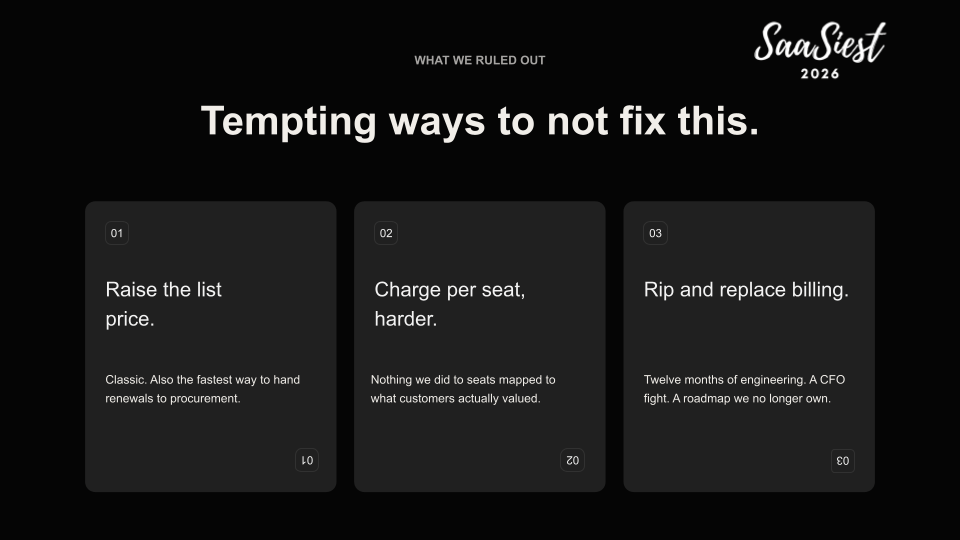
The obvious response might be to switch immediately to usage-based pricing.
According to Emil, that is often where companies go wrong.
The challenge is not designing a theoretically perfect pricing model. The challenge is creating organizational alignment around change.
Sales teams worry about more difficult renewal conversations. Finance teams worry about forecasting volatility. Engineering teams worry about large-scale billing system projects. Customers worry about unpredictable invoices.
Every stakeholder has legitimate concerns.
That is why Digital Route approached the problem differently. Rather than asking what the ideal pricing model should look like, they focused on identifying the smallest possible step that would move them in the right direction.
The first step was surprisingly simple.
They started measuring.
Before changing pricing, they invested in understanding usage patterns, tracking AI-related costs, and connecting customer behavior to operational expenses. Not because they intended to bill customers differently immediately, but because they needed visibility.
The lesson was straightforward: you cannot price what you cannot measure.
Why Hybrid Models Are Emerging
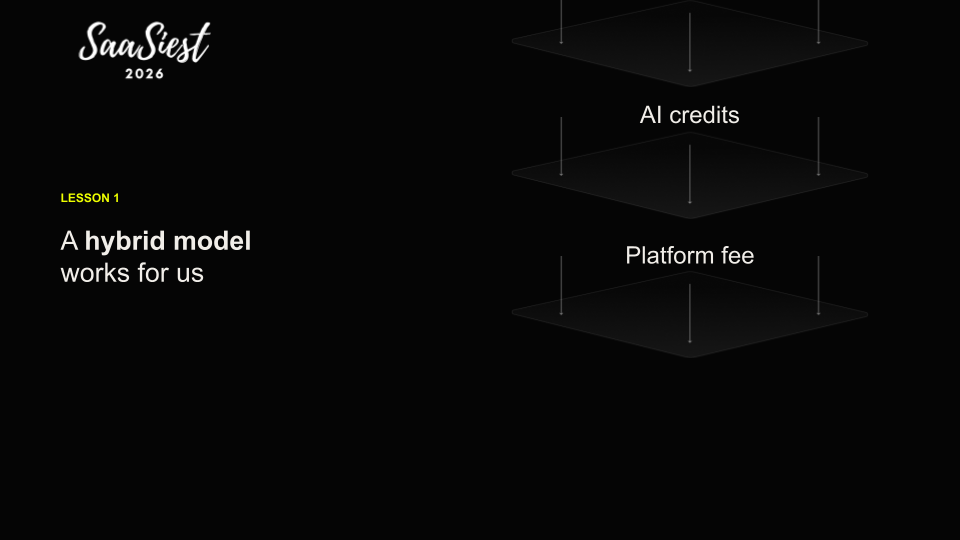
Eventually, Digital Route landed on a hybrid pricing structure.
Customers pay a platform fee that includes a predefined amount of AI usage. Beyond that threshold, additional usage is charged through tiered overages.
What makes the model interesting is not its complexity but its practicality.
The platform fee preserves predictability for both customers and finance teams. Included AI credits allow customers to experiment with new functionality without fear of immediate overage charges. Usage-based components create a clearer connection between customer value and revenue.
Most importantly, the model creates a gradual transition.
One of the biggest risks in moving toward usage-based pricing is introducing friction around adoption. If customers are worried about every interaction triggering additional charges, they may avoid using the very features companies want them to embrace.
The hybrid approach allows organizations to introduce usage-based thinking without creating that fear.
Pricing Is Becoming a Product Discipline
The most interesting takeaway from Emil’s presentation wasn’t the specific pricing model Digital Route chose.
It was his argument that product teams need to take ownership of pricing itself.
Historically, pricing has often been treated as a finance exercise. Product teams build features. Finance determines packaging. Sales communicates pricing to customers.
That separation becomes increasingly difficult to maintain in an AI-driven world.
Product teams define value. They understand customer behavior. They track adoption patterns. They run experiments and measure outcomes. In many cases, they are closer to understanding value creation than anyone else in the organization.
If pricing is ultimately about capturing value, then product teams cannot afford to treat it as someone else’s responsibility.
As Emil put it, pricing should be managed much like any other product capability: through instrumentation, experimentation, iteration, and continuous learning.
The Era of Static Pricing Is Ending
One of the most revealing statistics from the session was how frequently leading SaaS companies are now changing their pricing.
The largest SaaS companies in the world are updating pricing and packaging multiple times per year. Companies like Salesforce regularly adjust monetization models, while AI-native companies are experimenting even more aggressively.
That trend is unlikely to slow down.
AI is changing product economics too quickly for annual pricing reviews to keep pace. Costs shift. Customer expectations evolve. New categories emerge. Usage patterns change.
In that environment, pricing can no longer be treated as a document that gets updated once a year.
It becomes an ongoing product discipline.
The companies that succeed over the next decade may not be the ones that build the most AI features. They may be the ones that become best at aligning price with value as both continue to evolve.
Because in the age of AI, pricing is no longer just a commercial decision.
It’s a product decision.