

Why culture is the hardest thing to scale
Most SaaS founders obsess over scaling product and process. Few talk about scaling culture. Yet it’s often the difference between a team that compounds and one that collapses under its own growth.
The paradox? What makes early teams successful – speed, trust, shared context- tends to erode as headcount rises. Rules multiply. Managers layer in. Decision-making slows. Culture becomes a poster, not a practice.
Pieter van der Does, co-founder and CEO of Adyen, has lived this journey firsthand. Under his leadership, Adyen grew from a small payments startup to a global public company. And along the way, Pieter discovered a truth few founders confront: scaling culture requires as much design as scaling product.
He calls that framework the culture multiplier, the ability to make trust, talent, and long-term thinking scale faster than headcount.
From collapse to clarity
Before founding Adyen, Pieter sold his first startup to a 120,000-person corporate giant. Within six months, the energy that once fuelled the team was gone.
“It’s surprising how quickly you can kill a culture.”
Engineers were flying to London for reward dinners instead of writing code. Managers who couldn’t read code were suddenly making the calls. Travel policies replaced trust.
That experience, watching culture die inside bureaucracy, became the blueprint for doing things differently the next time around.
Writing down what matters
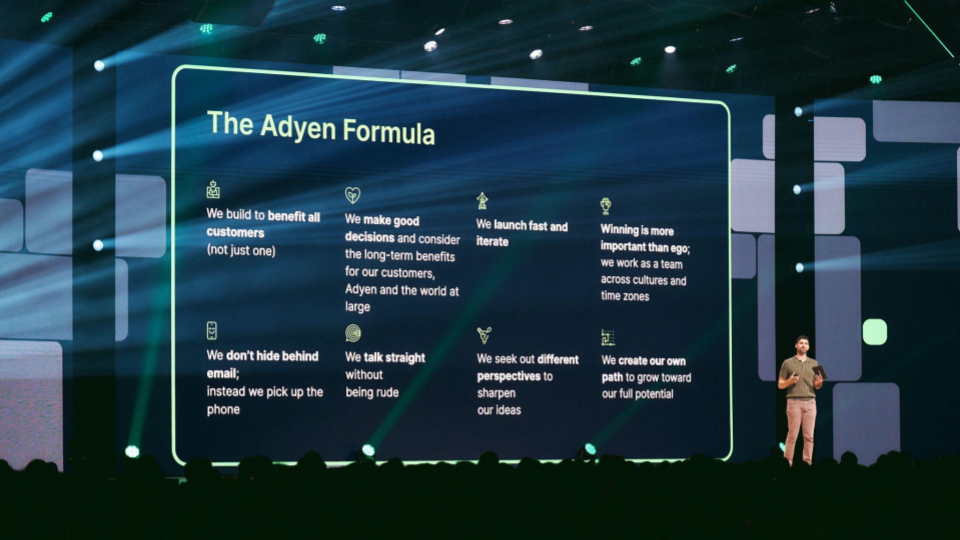
Five years into Adyen’s journey, Pieter and co-founder Arnout Schuijff realised they were repeating the same lessons in every conversation. So they codified them into what became known as the Adyen Formula – eight behavioural principles that translate company values into daily actions.
Unlike most corporate value statements, the Formula was deliberately instructional, not inspirational.
One line in particular became foundational:
“We build for the benefit of all customers.”
From day one, Pieter prioritised scalability and shared innovation over custom requests. “If it only benefits one customer, it doesn’t scale,” he said.
That clarity came from a painful experience. In his previous company, building a custom integration for a single large client created months of technical debt and risk. Every exception made the system slower.
The lesson became law. Adyen’s model of continuous innovation depends on improving the core product for everyone, not bending it for one.
Empower through clarity, not control
As Adyen scaled, Pieter’s focus shifted from product to people. His challenge: how to keep decision-making fast when thousands of smart people need autonomy?
The answer became a central pillar of the culture multiplier: delegate authority, not accountability.
“If you act according to the Formula, you can make decisions yourself.”
Teams are encouraged to “debug” ideas with peers before escalating. Product managers consult support teams before launch. Feedback loops replace hierarchy.
It’s not chaos, it’s structured freedom. When everyone knows the principles, approvals become unnecessary.
Hiring the nines
The culture multiplier starts with talent.
While many organisations spend their energy turning average performers into slightly better ones, Pieter takes the opposite approach: hire nines, not polish sixes.
Every candidate, even an office manager in another continent, meets a senior leader before joining. It’s a time-consuming process, but it protects the talent bar.
Managers under pressure may settle for “good enough.” Senior leaders don’t.
“If you can play tennis with Serena Williams, you won’t complain about how often you get new balls. You’ll just want to play.”
That’s the environment Pieter strives for: people motivated by the quality of their peers, not by perks or policies.
Trust over policy
Adyen famously runs with almost no travel policy.
If an account manager believes a trip to San Francisco is necessary, they can book it—no approval required. The only rule? The “no-blush test.”
“If you can explain your decision to the entire company without blushing, it’s probably the right one.”
That level of trust might seem risky, but it’s self-correcting. When someone abuses it, it usually points to a deeper issue – weak management or poor fit.
Trust, curiosity, and self-discipline are what keep the system balanced. “When you build for trust,” Pieter said, “you get performance for free.”
Feedback loops that evolve
Not every principle in the Formula aged perfectly. One line – launch fast and iterate, was originally designed to encourage quick feedback. As Adyen grew, engineers began interpreting it as permission to ship unfinished work.
Rather than removing it, Pieter refined it. The goal wasn’t speed; it was learning fast through customer feedback.
The Formula, like the company itself, continues to evolve. And that flexibility, structure without rigidity, is exactly what allows culture to scale.
Measuring what matters
At Adyen, culture isn’t symbolic – it’s operational.
The Formula shapes hiring, development, and performance reviews. Employees are measured not only on results but on how they work: collaboration, curiosity, and long-term alignment.
“We rarely let people go for lack of skill,” Pieter said. “But if they can’t work in this way – collaboratively, transparently, long-term, that’s when it turns sour.”
By embedding culture into operations, Adyen ensures that alignment scales faster than bureaucracy.
What leaders can learn
Scaling culture isn’t about slogans or perks. It’s about engineering trust and excellence into the operating system – so that decisions stay fast and principles stay consistent, even as the company grows exponentially.
That’s the essence of the culture multiplier:
✅ Codify behaviours, not buzzwords
✅ Hire for excellence, not average
✅ Replace rules with trust and accountability
✅ Let feedback loops evolve your systems
Adyen’s journey proves it: culture doesn’t have to dilute with growth. When leaders design for clarity, trust, and long-term impact, culture compounds right alongside revenue.
Watch Pieter’s full session from SaaSiest Amsterdam 2025 here: https://saasiest.com/scaling-a-culture-not-just-a-product/