



Your marketing team is generating more leads than ever. Pipeline is growing, campaigns are performing and the dashboards suggest everything is moving in the right direction. Sales has plenty of opportunities to work with, and the numbers look promising.
Yet deals keep stalling.
Some opportunities drag on for months. Others disappear late in the sales cycle. Prospects who seemed enthusiastic suddenly go quiet, and the people you’ve spent weeks convincing turn out not to have the authority to make the final decision.
What if the problem isn’t your pipeline, your sales process or even your product?
What if you’re simply talking to the wrong people?
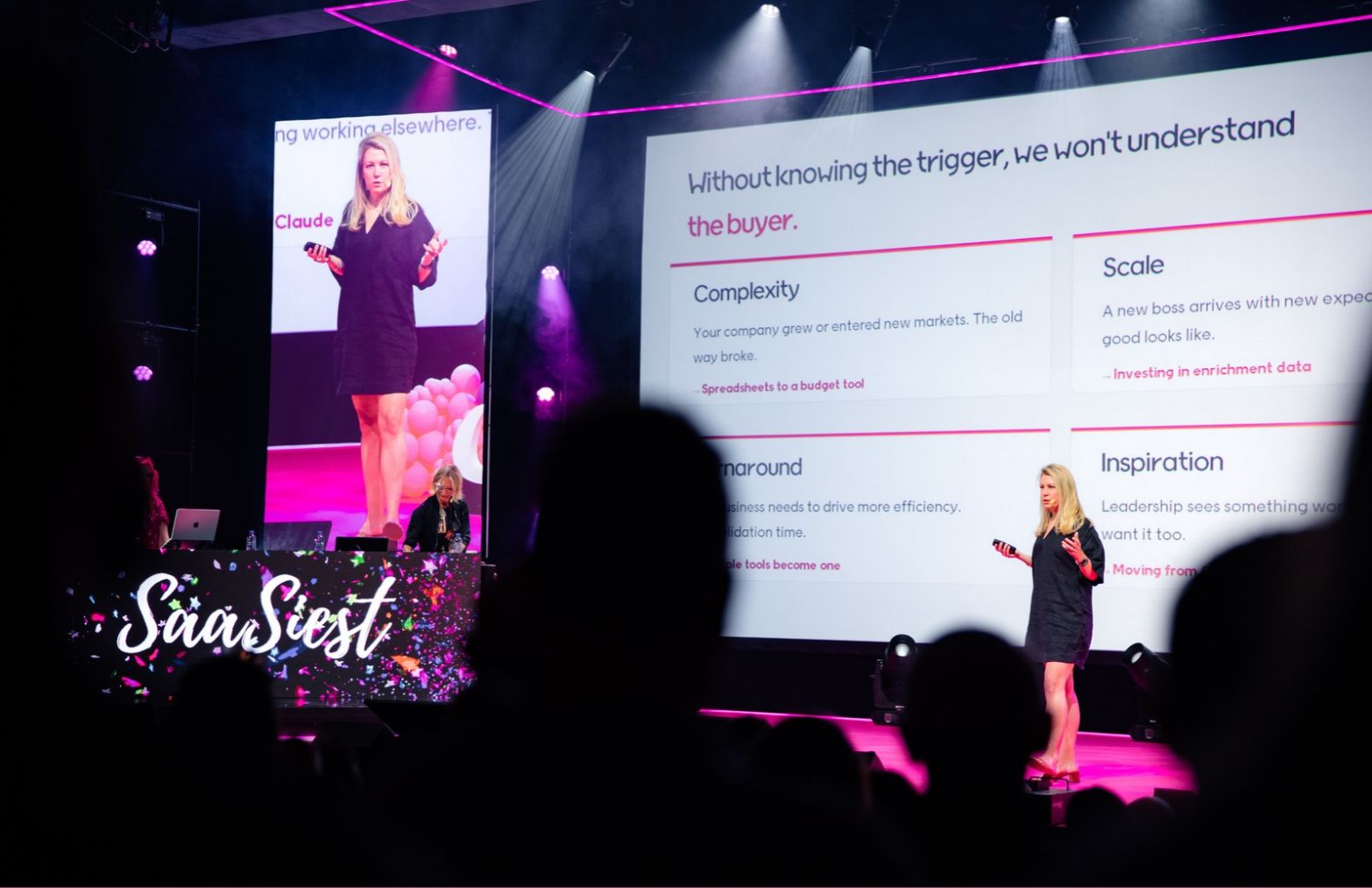
At SaaSiest 2026, Katarina Nordin, CMO at Voyado, challenged one of the most deeply embedded assumptions in B2B marketing: that the people we can identify, track and measure are necessarily the people who matter most in a buying decision.
Her argument was simple. We’ve become exceptionally good at measuring leads, but we haven’t become equally good at understanding buyers. And that gap might explain why so many SaaS companies struggle to turn marketing activity into revenue.
We’ve Built Our Marketing Around the Wrong Unit
For years, B2B marketing has revolved around the lead. Someone downloads a whitepaper, attends a webinar, fills out a form or requests a demo. Their activity gets recorded, scored and eventually passed to Sales.
It’s a convenient model because it’s measurable. Marketing can demonstrate how many leads it generated, how many became opportunities and how much pipeline those opportunities represent.
But convenience doesn’t necessarily mean accuracy.
Katarina argued that marketers have become so focused on measurability that they’ve sometimes lost sight of how purchasing decisions actually happen. When a metric becomes the primary target, teams naturally optimise for it, even when that metric is only a weak indicator of the outcome they really want.
That’s how companies end up generating more leads without generating more revenue.
Even when organisations evolve beyond MQLs and start measuring marketing-generated pipeline, the underlying problem can remain. The opportunity exists, the CRM records the activity and Marketing receives credit for creating it. But the deal still doesn’t close.
The reason is that a lead is an individual, while a B2B purchase is an organisational decision.
And those are two very different things.
The Buying Journey Doesn’t Start With Your Campaign
Traditional marketing funnels assume that buyers move through a relatively predictable sequence. They become aware of a problem, engage with content, develop interest, evaluate solutions and eventually make a purchase.
But think about the last time your company bought a significant piece of software. Did the process really begin because someone clicked an advertisement or downloaded a guide?
Probably not.
More likely, something changed inside the organisation.
A process stopped working. A new executive arrived. The company entered a new market. Costs became unsustainable. Someone saw a better way of doing things and started asking questions.
That internal event created the need to buy.
Katarina’s point was that leads start with awareness, but buying starts with a trigger.
Understanding that distinction changes how companies should approach their go-to-market strategies. Instead of asking which individuals are engaging with marketing, teams should first understand what is happening inside an organisation that might cause it to reconsider its existing way of working.
Katarina identified four common triggers: complexity, scale, turnaround and inspiration.
Complexity appears when existing processes can no longer support the business. A spreadsheet that worked perfectly for a small team becomes unmanageable as more people, markets and reporting requirements are added.
Scale creates demand when an organisation enters a new phase of growth. A new leadership team might introduce higher expectations, new processes or technologies that weren’t necessary before.
Turnaround happens when a company needs to improve efficiency, reduce costs or consolidate its technology stack. Instead of buying more tools, the organisation starts questioning whether it needs all the tools it already has.
Inspiration is different. Sometimes a leader simply encounters a new technology or approach and decides the company should explore it. An executive sees what AI can do, sends a message to the team and suddenly an evaluation process begins.
These triggers matter because they help explain not only why a company might buy, but also who is likely to influence the decision.
The Person in Your CRM Might Not Be the Buyer
One of the most memorable examples from Katarina’s session involved a senior female executive attending a business meeting with two male colleagues.
Throughout the presentation, the salesperson directed his attention almost entirely towards the two men. He explained the proposal, answered questions and discussed next steps without meaningfully engaging the woman sitting beside them.
At the end of the meeting, he asked the men what they thought.
One of them turned towards the woman and explained that the decision was hers.
The salesperson had spent the entire meeting overlooking the actual decision-maker.
It’s an uncomfortable example, but it illustrates a much broader problem in B2B sales.
The person attending meetings isn’t necessarily the person who initiated the purchase. The person asking technical questions might not control the budget. And the person who ultimately decides whether the deal moves forward might never participate in a sales conversation.
Sometimes that person is a senior executive directing the process through internal Slack messages. Sometimes it’s a finance leader questioning the business case. Sometimes it’s someone in procurement, legal or IT who has the authority to block the purchase.
Yet most CRM systems are still organised around contacts and opportunities, with particular attention given to the primary contact.
That creates a dangerous blind spot.
Companies become highly effective at engaging the people they can see while remaining largely unaware of the people influencing the decision behind the scenes.
Every Buying Committee Has More Than One Kind of Power
Katarina suggested approaching buying committees through a simple framework that identifies the different roles people play in a purchase.
The sponsor is often the person who creates the momentum behind the decision. They recognise the problem, understand why something needs to change and may have the authority or influence to make it happen.
The driver is typically the person managing the evaluation. They’re the ones attending meetings, comparing vendors and coordinating the process. Unsurprisingly, they’re also the people most likely to appear as primary contacts in the CRM.
Researchers help gather information and assess alternatives. Users care about how the product will work in practice and whether it will make their jobs easier. Depending on the product, their influence can be significant, particularly when adoption or usage directly affects the commercial value of the solution.
Then there are the gatekeepers.
Legal, procurement, security, finance and IT may not have initiated the purchase or participated in early discussions, but they can still determine whether it happens.
A deal can progress smoothly for months before encountering an objection from someone who has never spoken to the vendor.
The challenge isn’t simply identifying everyone involved. It’s understanding what each person cares about, how much influence they have and how their role changes depending on the reason the company is buying.
A purchase triggered by rapid growth might be driven by an ambitious executive looking for new capabilities. A purchase triggered by cost reduction might involve a finance leader with very different priorities.
The same product can have entirely different buying dynamics depending on the trigger.
That’s why Katarina argued that understanding the buying committee starts with understanding the reason for the purchase.
The Most Valuable Marketing Might Be Invisible to Your Funnel
Katarina shared an example from her previous experience at Adyen, where her team developed a programme specifically designed to engage senior executives.
The approach deliberately avoided some conventional marketing practices.
Instead of relying on gated content and forms, the team focused on building relationships between executives. They created opportunities for meaningful engagement and tracked those interactions, sometimes using something as simple as a spreadsheet.
The results were significant.
According to Katarina, deals associated with the programme were three times more likely to close.
The important detail wasn’t the technology used to track the programme. It was that the team had identified influential people who weren’t necessarily appearing in traditional marketing attribution.
They understood the role those executives played in the buying process and created a strategy to reach them.
But if the organisation had judged the programme primarily by form submissions or MQL generation, much of its value might have remained invisible.
This exposes a fundamental weakness in how many SaaS companies measure marketing.
The activities that are easiest to attribute aren’t always the activities that create the most commercial impact.
An executive conversation, a trusted recommendation or an internal discussion between stakeholders might influence a deal more than dozens of measurable campaign interactions.
Yet those moments rarely fit neatly into a funnel dashboard.
Sometimes the Hidden Buyer Is the Person Using the Product
The hidden buyer isn’t always a senior executive.
Katarina also described an example involving the adoption of an additional payment method. Different payment methods come with different commercial implications, but they can also create significant value by improving the purchasing experience for customers.
Rather than focusing exclusively on senior decision-makers, the team engaged people closer to the day-to-day use of the product.
These individuals weren’t necessarily involved in commercial negotiations, but they understood the operational opportunity and could act on it.
The initiative produced a substantial commercial impact, demonstrating how influence can sit much closer to the product than traditional sales processes assume.
The broader lesson is that buying power isn’t always defined by job title.
In some situations, a CEO creates the demand. In others, a department leader drives the evaluation. And sometimes, the person who can create the greatest impact is an existing user who understands exactly what needs to change.
The challenge for SaaS companies is recognising where that influence sits before deciding how to engage it.
Your CRM Can’t Tell You Everything You Need to Know
None of this means that CRM systems, attribution models or marketing metrics are useless.
They remain essential tools for managing commercial activity and understanding performance.
But Katarina’s argument was that companies need to stop treating the information they capture as a complete representation of how customers buy.
A CRM can tell you who attended a meeting, opened an email or requested a demo. It may tell you which contacts are associated with an opportunity and how that opportunity progresses through the pipeline.
What it often cannot tell you is who originally created the urgency, which internal conversations shaped the decision or who ultimately convinced the organisation to move forward.
Those questions require a different kind of investigation.
Marketing and Sales need to work together to understand the buying triggers within their target accounts, map the likely stakeholders and validate those assumptions through customer conversations and research.
They also need to become more comfortable investing in activities whose value might not be immediately visible in conventional attribution.
That requires judgement, experimentation and a willingness to challenge established reporting practices.
And perhaps most importantly, it requires measuring success against actual business outcomes rather than relying exclusively on the metrics that happen to be easiest to collect.
Stop Optimising for Leads. Start Understanding Buyers.
The uncomfortable truth is that a company can have a sophisticated marketing technology stack, detailed attribution reporting and a highly optimised funnel while still misunderstanding how its customers make decisions.
It can generate more leads, create more opportunities and increase campaign engagement without meaningfully improving its ability to close deals.
Because the people driving those deals forward may not be the people Marketing is targeting.
Katarina’s message wasn’t that SaaS companies should abandon data or stop measuring performance. It was that they should return to first principles and remember what those systems are supposed to help them achieve.
The goal isn’t to generate a lead.
The goal is to help an organisation make a buying decision.
And that means understanding what triggered the need, who has influence, what each stakeholder cares about and which obstacles could prevent the purchase from happening.
Sometimes the most important person in that process will never download your whitepaper, attend your webinar or appear in your CRM.
But if you don’t understand who they are, you might never understand why your deals keep stalling.